
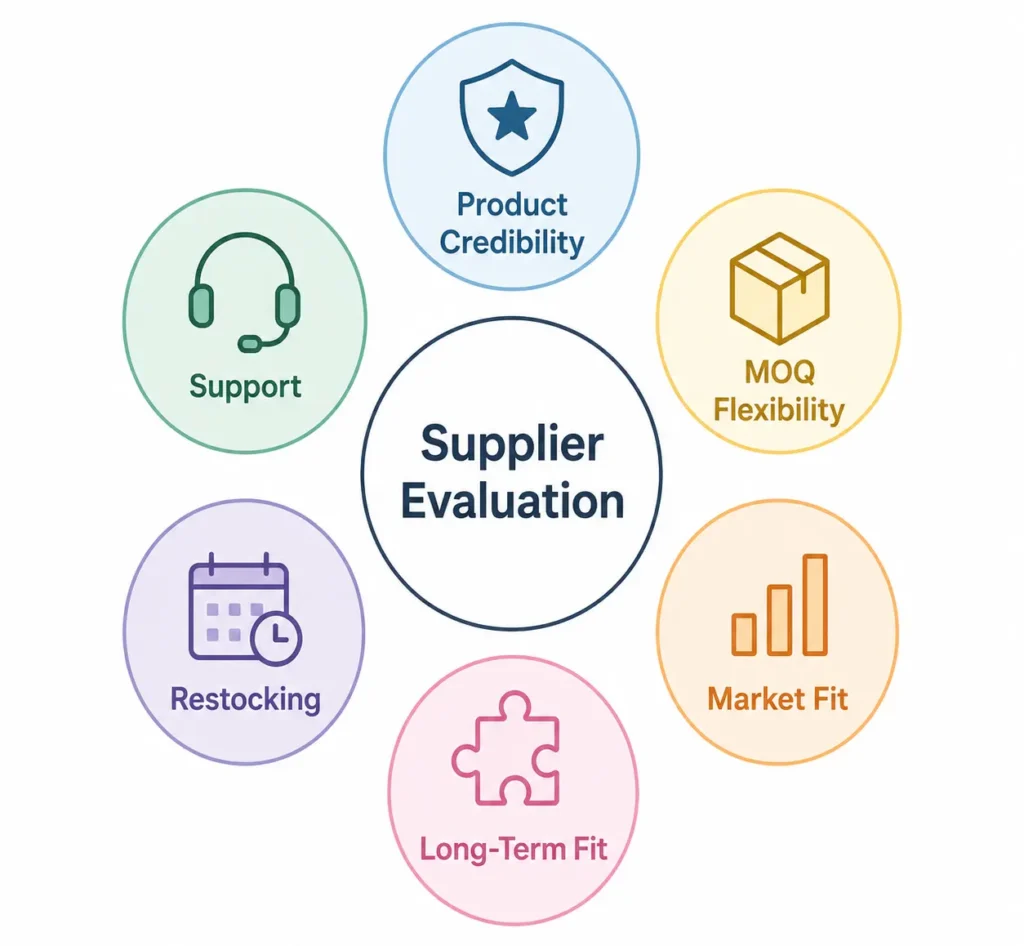
Finding suppliers is not difficult. The difficult part is working out which one can support your business after the first quotation has been sent.
Several suppliers may show similar catalogs, offer competitive prices, and respond quickly. None of those signals tells you whether the documents match the products, whether the MOQ can be divided into useful SKUs, or whether a best-selling lens will still be available when you need it again.
A supplier that looks cheaper on paper can become far more expensive after a few months of stock gaps, unclear specifications, or difficult repeat orders.
This guide helps distributors, beauty retailers, optical stores, and ecommerce sellers evaluate a colored contact lens wholesale supplier before committing inventory and capital.

Do Not Evaluate a Supplier by Price Alone
Unit price is easy to compare, which is why buyers often give it too much weight.
The real cost of working with a supplier also includes:
- Stock that does not fit local demand
- Products that cannot be reordered reliably
- Unclear or inconsistent documentation
- Inflexible minimum quantities
- Incorrect SKUs or order quantities
- Delays that leave best sellers unavailable
A small difference in price matters less when one supplier helps you build a practical assortment and another leaves you with slow-moving inventory.
Catalog size can be misleading for the same reason. A supplier may show hundreds of designs, but buyers still need to know which products are active, which are actually available, and which can be supplied consistently.
Fast replies are useful. Accurate replies are more useful.
When the answer changes between the chat, quotation, catalog, and order confirmation, response speed does not reduce risk.
A quotation only becomes comparable when the specifications, MOQ structure, stock status, documents, and delivery terms are clear. Our guide to what to ask before requesting a colored contact lens price list explains which details should be confirmed before comparing unit prices.
Verify Product Information and Documentation
Start with the products themselves.
The supplier should be able to provide enough information for you to understand exactly what is being quoted. Depending on the range, this may include:
- Replacement cycle
- Available powers
- Diameter and graphic diameter
- Base curve
- Water content
- Material
- Packaging format
- Product and SKU names
You do not need to collect technical files simply to make the order look more professional. The purpose is to check whether the supplier understands its own product range and whether the information remains consistent.
Match the documents to the actual products
A certification logo in a catalog is not enough on its own.
The available documents should be relevant to:
- The products being quoted
- The manufacturer or responsible company
- The destination market
- The models or product categories covered
- The current validity period
Requirements vary between countries and sales channels. A useful supplier response is not a folder containing every certificate the company owns. It is a clear explanation of which documents apply to the products and market under discussion.
Compare the details across materials
Check whether the same information appears in the:
- Catalog
- Quotation
- Product specification sheet
- Packaging
- Supporting documents
Minor naming differences may have a reasonable explanation. More important inconsistencies should not be ignored.
For example, if the manufacturer name changes between documents, the product parameters do not match, or the salesperson cannot explain which range a certificate covers, pause and ask for clarification.
One mismatch does not automatically make the supplier unsuitable. An unexplained mismatch does make the next step harder to justify.
Look Beyond the MOQ Number
Many buyers begin with:
What is your MOQ?
A more revealing question is:
How can the MOQ be divided?
Two suppliers may both offer a minimum order of 100 pairs. One may require most of that quantity in a single design, while another may allow the order to be spread across several colors and styles.
For a new seller, those are completely different offers.
Ask how the MOQ works in practice:
- Is it calculated per order, series, color, or SKU?
- What is the minimum quantity per SKU?
- Can different collections be combined?
- Can monthly and 6-month lenses be included in one order?
- Do powered options change the minimum?
- Are repeat-order conditions different?
A low MOQ is useful only when it produces a commercially sensible assortment.
For example, an order structure of 100 pairs with a minimum of 5 pairs per SKU gives a buyer room to test several products instead of placing the entire commitment into one design.
That flexibility matters most when demand is still uncertain. A structured first order can reveal which colors, effects, and replacement cycles deserve more inventory. See how sellers can test a colored contact lens market with only 100 pairs.
MOQ flexibility also creates the next question: are the products worth testing in your market?
Check Whether the Catalog Fits Your Customers
A large catalog is not automatically a useful catalog.
The more practical question is:
Can I build a balanced collection for the customers I actually serve?
A beauty shop may need dependable everyday products. A social-commerce seller may need lenses with stronger visual impact. An optical store may place more weight on powered availability and clear product specifications.
A useful range may include:
- Everyday natural styles
- Visible enlargement options
- Soft and bold transformation effects
- Core brown and gray colors
- Distinctive standout designs
- Different replacement cycles and powers
Not every buyer needs every category. The supplier needs enough range to support a collection that makes sense for the buyer’s country and sales channel.
A catalog should help you make decisions
Buyers should not need a separate conversation to identify every product.
A clear wholesale catalog normally shows:
- Series name
- SKU
- Color
- Replacement cycle
- Available power range
- Product or on-eye image
- Packaging
- Relevant specifications
Organization matters more than decoration. When products are poorly labeled, buyers can easily select several lenses that look different in the catalog but serve the same commercial role.
Suppliers should also be able to point out which products are:
- Reliable repeat sellers
- New arrivals
- Visually distinctive
- Suitable for first-time buyers
- Better matched to particular channels or markets
This guidance should support the buyer’s judgment, not replace it.
Once the catalog looks commercially relevant, the next job is reducing it to a manageable starting range. Our guide to choosing your first 10 lens styles without overstocking covers that decision in more detail.
Evaluate Stock and Restocking as One System
Many buyers ask whether a product is currently available. Fewer ask what will happen when it sells out.
That second question often matters more.
A supplier can complete one order successfully and still become difficult to work with when only two or three SKUs need replenishment.
| What to confirm | Why it matters |
|---|---|
| Actual available stock | Prevents selected products from becoming unavailable after the order is prepared |
| Production lead time | Distinguishes ready stock from products that still need to be made |
| Repeat-order MOQ | Shows whether fast sellers can be replenished economically |
| Restocking lead time | Helps prevent sales gaps |
| Regional warehouse availability | May shorten replenishment for local markets |
| Product continuity | Reduces unexpected changes between batches |
“In stock” should mean that the quantity can be allocated to your order. It should not mean that the product might be produced or transferred later.
Ask which SKUs are normally stocked, how often inventory is updated, and whether available quantities can be confirmed before payment.
Repeat-order terms deserve the same attention. A flexible first order loses much of its value when replenishment later requires a much larger commitment.
Product continuity also matters. Buyers should know whether future batches will maintain reasonably consistent:
- Color and pattern appearance
- Specifications
- Packaging
- SKU identification
Customers notice when the same SKU looks or arrives differently. Store staff notice too.
For Southeast Asian sellers, regional inventory can reduce the delay between identifying a fast-moving product and returning it to sale. Warehouse location is useful, but only when it is supported by accurate stock information and workable repeat-order terms. Learn how local warehouses help colored contact lens sellers restock faster in Southeast Asia.
Judge Communication by Accuracy, Not Message Count
Some suppliers reply quickly but leave the buyer with the same uncertainty.
A useful answer should move the order forward.
Before ordering, the sales team should be able to explain:
- MOQ and SKU allocation
- Available stock and powers
- Lead time
- Product documents
- Packaging
- Payment and shipping
- Repeat-order conditions
Vague phrases such as “available,” “no problem,” or “fast delivery” are not enough when exact quantities and dates affect the order.
During the transaction, look for whether the supplier:
- Confirms the final SKU list
- Checks quantities and missing information
- Identifies stock problems early
- Provides a clear order summary
- Communicates changes before they become surprises
After-sales handling is another useful test. Ask what happens if the shipment contains an incorrect SKU, a quantity difference, damaged packaging, or missing goods.
The point is not to assume that problems will occur. It is to see whether the supplier has a process when they do.
Good supplier communication reduces uncertainty. It does not simply increase the number of messages.
Consider Whether the Relationship Can Grow
A supplier may be perfectly capable of handling one small order and still be a poor fit for a growing distributor.
Think beyond the first transaction.
What happens when you need:
- More SKUs
- More frequent shipments
- Deeper stock in best sellers
- Product updates
- Support for another sales channel
- A broader regional assortment
A wholesale-focused supplier should understand that buyers are managing a collection, not purchasing isolated products.
That means understanding issues such as:
- Assortment balance
- Inventory risk
- Replenishment
- Product continuity
- Retail and ecommerce presentation
- Regional customer preferences
Useful commercial support may also include organized catalogs, product images, on-eye references, packaging materials, and regular product updates.
None of these materials can guarantee sales. They do make it easier for the distributor to list, explain, and reorder products consistently.
A supplier that only performs well while chasing the first payment may not perform as well after the account becomes operational.
Once the broader relationship looks workable, use a first wholesale order checklist to confirm quantities, SKU allocation, documents, payment terms, and delivery details.
Warning Signs That Need a Clearer Answer
Some issues justify further verification before money is transferred or the order is increased.
Pay closer attention when:
- Product information changes between conversations
- Documents cannot be matched to the quoted products
- Stock availability remains vague
- MOQ rules change after product selection
- Lead times are not confirmed in writing
- The quotation leaves out important costs or conditions
- Repeat-order questions receive unclear answers
- The supplier pushes a large order without asking about the market
- Catalog products lack clear SKU or replacement-cycle information
These signs do not always prove that the supplier is unsuitable.
They do mean that the buyer needs better evidence.
A reasonable next step may be requesting an updated quotation, revised documents, written stock confirmation, or a clearer explanation of the order terms.
The objective is not to eliminate every possible risk. It is to avoid making a commercial decision based mainly on assumptions.
Use the First Order to Confirm the Claims
Passing the initial review does not mean the supplier has already proved everything.
The first transaction should remain proportionate to what you have verified. It gives you a chance to see whether the promised product information, SKU allocation, communication, packaging, and delivery process appear in the actual order.
A practical approach is:
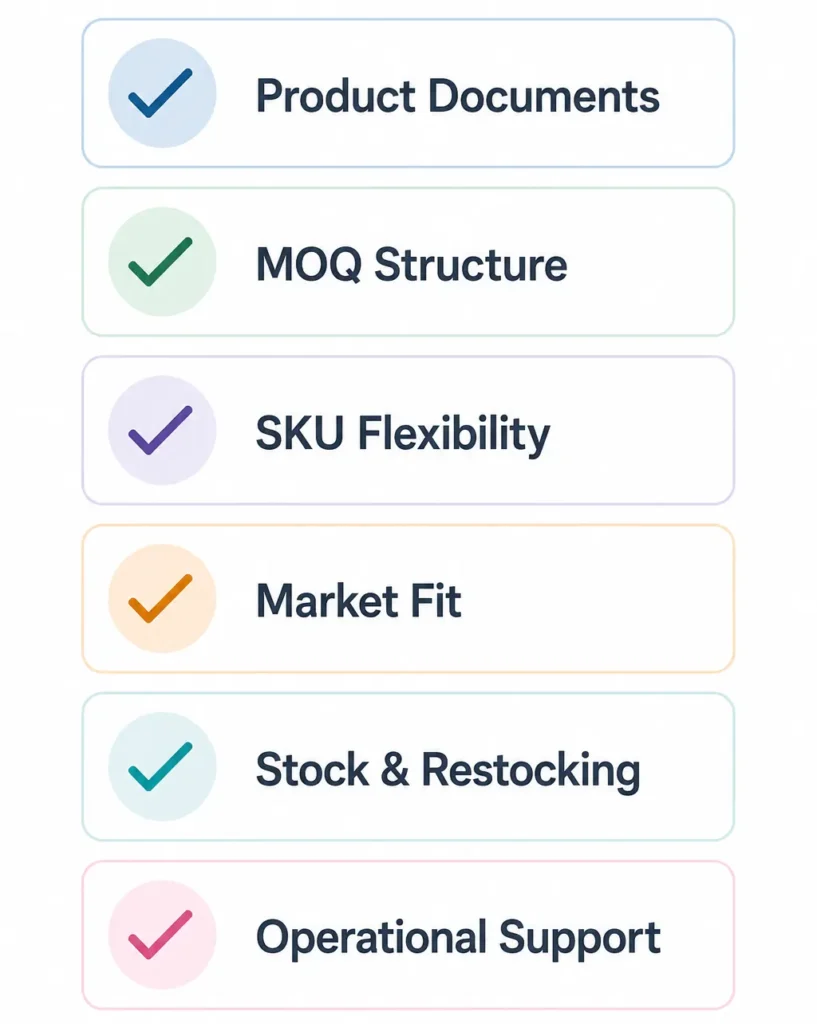
- Verify the essential product information and relevant documents.
- Confirm MOQ, SKU allocation, stock, lead time, and delivery terms in writing.
- Keep the initial commitment appropriate to the level of market uncertainty.
- Review the complete order before expanding the relationship.
The first order is not only a purchase. It is the first real test of the supplier’s operating system.
Choose Evidence Over Promises
The best colored contact lens wholesale supplier is not necessarily the one with the lowest quotation, largest catalog, or most persuasive salesperson.
A stronger candidate is the one that can show:
- Consistent product information
- Practical MOQ and SKU rules
- A range suited to the target market
- Reliable stock and replenishment
- Accurate operational communication
- Support that remains useful after the first sale
The goal is not to find a risk-free supplier. That supplier does not exist.
The goal is to replace avoidable uncertainty with enough evidence to make a controlled first commitment.
Evaluate UYAAI for Your Market
UYAAI works with colored contact lens distributors, wholesalers, beauty retailers, optical stores, and ecommerce sellers across Southeast Asia.
Wholesale orders start from 100 pairs, with a minimum of 5 pairs per SKU, allowing buyers to test several styles without placing the full order into one design.
UYAAI also provides organized wholesale collections, product information, distributor-oriented support, and regional inventory through self-operated warehouses in Vietnam, Indonesia, Malaysia, and Thailand.
To assess whether the range fits your country and sales channel, review the wholesale catalog and share your market, preferred replacement cycles, and expected order quantity with the UYAAI team.