
Choosing products for a first wholesale order is partly a test of judgment. Planning the next order should rely much more heavily on evidence.
Once a colored contact lens collection has been on sale for several weeks, patterns begin to appear. Some products attract attention but convert slowly. Others receive less social engagement but sell consistently. A few may sell out quickly, although only because the opening quantity was small.
This is why remaining stock alone cannot tell you what to reorder.
A style is not automatically a best seller because it sold out. In the same way, a style with inventory remaining is not necessarily unsuccessful. It may have launched later, received less exposure, been presented with weak product images, or been stocked in the wrong power range.
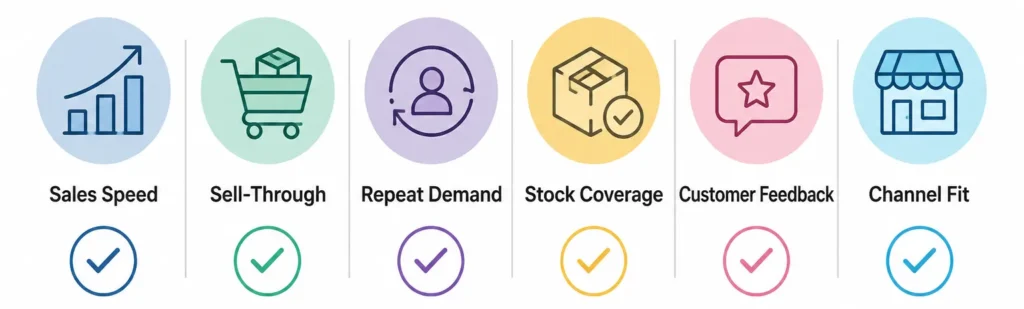
A useful restocking decision combines sales speed, sell-through, repeat demand, remaining inventory, customer feedback, and channel performance.
This guide explains how colored contact lens distributors, beauty shops, optical retailers, and ecommerce sellers can use those signals to decide which products to restock, monitor, reduce, or stop reordering.

Start with the Right Restocking Question
The most common question is:
Which style sold the most?
A more useful question is:
Which style is most likely to continue selling after I reorder it?
Total sales can be influenced by launch dates, promotions, opening quantities, discounts, advertising, and differences between sales channels.
For example, a product that sells 20 pairs over eight weeks is performing differently from one that sells 15 pairs in two weeks. The second product has lower total sales but much stronger sales velocity.
Short-term attention can also distort the result. A lens may sell quickly after appearing in a popular video, then slow down once the content stops receiving traffic. Another design may start more quietly but build stable demand through store recommendations and repeat customers.
The data needs context.
High sales may come from:
- A temporary promotion
- A viral post
- A small opening quantity
- Seasonal demand
- One popular color or power
Slow sales may come from:
- Limited exposure
- Weak product images
- Missing popular powers
- Poor store placement
- A mismatch between the product and sales channel
Before removing a slow product, check whether the problem is the product itself or the way it is being sold. Improving your colored contact lens display and visibility may change the result for products that customers have not noticed properly.
Track Five Signals Before You Restock
No single metric gives a complete answer. A practical review should combine five signals.
1. Sales Velocity
Sales velocity measures how quickly a product sells during a defined period.
It can be recorded as:
- Pairs sold per week
- Pairs sold per month
- Average daily sales
- Sales since launch
The important point is to compare similar periods.
| Style | Units Sold | Selling Period | Average Sales Speed |
|---|---|---|---|
| Natural Brown A | 20 pairs | 4 weeks | 5 pairs per week |
| Grey Big-Eye B | 15 pairs | 2 weeks | 7.5 pairs per week |
| Pink Hybrid C | 10 pairs | 8 weeks | 1.25 pairs per week |
Natural Brown A has the highest total sales, but Grey Big-Eye B is selling faster.
If the same pattern continues, Grey Big-Eye B may need restocking earlier.
This is why sellers should avoid comparing a product’s eight-week performance with another product’s first few days.
2. Sell-Through Rate
Sell-through rate compares the quantity sold with the quantity originally received.
Sell-through rate = units sold ÷ units received × 100
For example:
- Units received: 20 pairs
- Units sold: 15 pairs
- Sell-through rate: 75%
This helps distinguish real demand from a small opening quantity.
Consider two products:
- Style A received 10 pairs and sold all 10.
- Style B received 40 pairs and sold 30.
Style A achieved 100% sell-through. Style B achieved 75% but sold three times as many pairs.
Both may deserve restocking. They probably should not receive the same reorder quantity.
The review period matters too. A 75% sell-through rate after three weeks is more meaningful than the same rate after nine months.
3. Repeat Customer Demand
Initial purchases often reflect curiosity. Repeat purchases provide stronger evidence that a style has lasting value.
Useful signals include:
- Customers buying the same style again
- Shoppers asking when it will return
- Buyers requesting another power
- Store staff repeatedly recommending it
- Resellers adding it to another order
Natural brown, grey, soft-glam, and other everyday styles may receive less dramatic social engagement than bold colors. Their repeat demand can still make them more dependable core products.
Repeat demand is often more valuable than first-purchase curiosity.
4. Stock Coverage
Stock coverage estimates how long the remaining inventory can support the current sales rate.
For example:
- Average weekly sales: 5 pairs
- Remaining inventory: 10 pairs
- Estimated stock coverage: 2 weeks
This helps determine when to reorder, not only whether a product deserves another order.
A strong-selling style with six weeks of inventory remaining may not need immediate replenishment. Another product with only one week of coverage may require action now.
The correct timing also depends on:
- Supplier preparation
- Shipping
- Customs clearance
- Warehouse transfer
- Local delivery
- Order confirmation
Waiting until stock reaches zero creates an avoidable sales gap. Regional availability can help reduce colored contact lens restocking delays, but the review should still begin before the last units are sold.
5. Channel Performance
The same product can perform very differently across channels.
A natural grey lens may sell steadily in an optical store because it is easy to recommend for everyday use. A standout or big-eye style may perform better on TikTok, where the visual difference is immediately visible.
Review performance across channels such as:
- Beauty shops
- Optical stores
- TikTok
- Shopee
- Lazada
- Ecommerce websites
- Independent resellers
A product with moderate overall sales may still deserve selective restocking when it performs strongly in one strategically important channel.
Separate Your SKUs into Four Restocking Groups
Once the main signals are recorded, place every product into one of four groups.
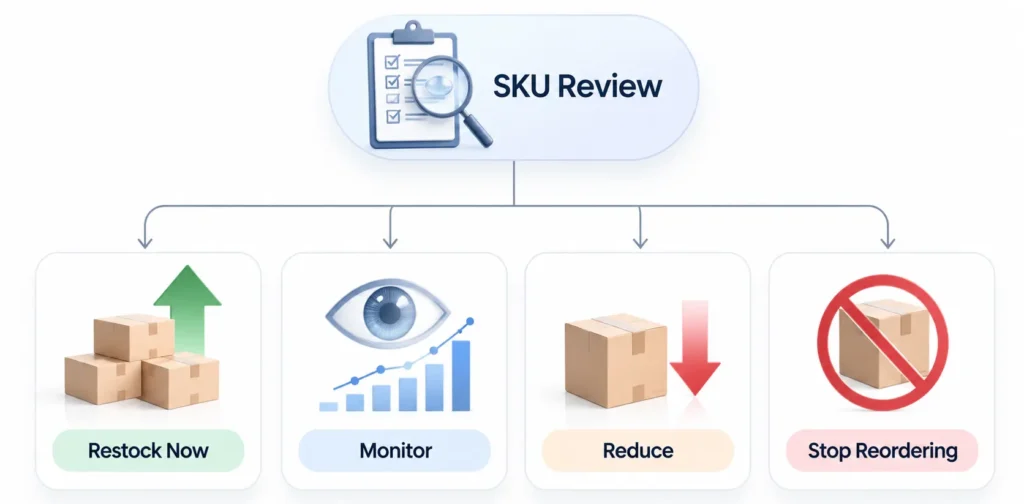
Restock Now
Products in this group usually show several of these signals:
- Fast sales velocity
- Strong sell-through
- Repeat customer demand
- Low remaining stock
- Consistent performance across several weeks
- A clear role in the collection
Do not wait until these products are completely unavailable.
When a core product reaches zero stock, the loss is not limited to the missing units. Customers may choose another seller, store staff may stop recommending the style, and advertising content may continue sending traffic to an unavailable product.
Monitor
The Monitor group is for products that do not yet have enough data for a confident decision.
Examples include:
- Recently launched styles
- Products with moderate sales and positive feedback
- Styles performing well in one channel
- Products with demand concentrated in a narrow power range
- Seasonal colors approaching their main selling period
Monitoring should have a time limit.
Set a review period of two to four weeks. During that period, improve the images, change the display, test another channel, or restore missing powers. Then decide whether the SKU should move to Restock, Reduce, or Stop.
Reduce
Some products have real demand but do not deserve the same inventory depth as core sellers.
These may include:
- Slow but steady styles
- Seasonal products
- Channel-specific colors
- Differentiation styles
- Products selling mainly in selected powers
In these cases, reduce the quantity before removing the product completely.
Reduce depth before removing variety.
A distributor might lower a slower style from 20 pairs to 5 or 10 pairs while keeping it available as part of a broader, balanced assortment.
Stop Reordering
Regular replenishment may no longer make sense when a product shows:
- Low sales over several review periods
- Little or no repeat demand
- Weak performance after improved promotion
- Excessive similarity to a stronger product
- Persistent expectation problems
- No clear role in the collection
Stopping routine reorders does not mean the product can never return. It may still be tested during a seasonal campaign or through a new channel.
It simply should not continue receiving inventory priority without new evidence.
Review Color and Power Performance Separately
A product family may appear successful while most of its sales come from one color or a small group of powers.
Suppose a grey design sells well overall. A closer review may show that most purchases came from:
- Plano
- -1.50
- -2.00
- -2.50
If the remaining powers move slowly, copying the original allocation will recreate the same excess inventory.
The same principle applies to colors. Brown may become the core seller while blue or pink remains useful mainly for display or social content.
| Performance Pattern | Restocking Action |
|---|---|
| Style sells across most powers | Restock a broad power range |
| Only common powers sell consistently | Narrow the power allocation |
| Plano performs much better | Prioritize cosmetic demand |
| One color leads the product family | Shift quantity toward that color |
| Demand is fragmented and slow | Reduce overall inventory depth |
This level of review prevents a strong design from being weakened by a poor SKU allocation.
Use Customer Feedback to Explain the Numbers
Sales data shows what happened. Customer feedback can help explain why.
Pay attention to repeated comments about:
- Natural appearance
- Visible enlargement
- Color accuracy
- Product photography
- Staff recommendations
- Comfort expectations
- Missing powers
- Differences between online images and actual appearance
One opinion should not determine a wholesale order. Repeated feedback across several buyers or sales staff deserves more weight.
A product with moderate sales but frequent repeat requests may become a stable core item. A product with high sales and repeated complaints may require caution before a larger reorder.
High traffic with low conversion can point to a price, image, or expectation problem rather than weak interest in the design itself.
The objective is not to find a perfect product. It is to understand why each product is performing the way it is.
Evaluate the Role of Each Product
Not every style needs to become the highest-volume seller.
A commercially useful collection includes different product roles.
| SKU Role | Business Purpose |
|---|---|
| Core seller | Produces stable volume and repeat purchases |
| Traffic style | Attracts views, clicks, or store attention |
| Margin style | Supports stronger profit per sale |
| Differentiation style | Makes the collection less generic |
| Test style | Measures emerging demand |
A bold hybrid style may never outsell a natural brown lens. It may still help generate social content, improve a store display, or distinguish the collection from competitors.
That product may belong in the Reduce group rather than the Stop group.
This is where restocking decisions connect with the broader need to build a balanced colored contact lens collection. The objective is not equal sales across every SKU. It is a portfolio in which each retained product has a clear commercial role.
Use a Simple Restocking Scorecard
Small and mid-sized sellers do not need complex inventory software to make better decisions.
A simple spreadsheet can record the main signals.
| Signal | Strong | Medium | Weak |
|---|---|---|---|
| Sales speed | Fast | Stable | Slow |
| Sell-through | High | Moderate | Low |
| Repeat demand | Frequent | Occasional | None |
| Customer feedback | Positive | Mixed | Negative |
| Stock coverage | Low | Adequate | Excess |
| Channel fit | Clear | Limited | Unclear |
A simple interpretation is enough:
- Mostly Strong: Restock Now
- Mostly Medium: Monitor
- Strong demand with excess inventory: Delay the reorder
- Weak performance across several signals: Reduce or Stop
- Strong performance in one channel: Restock selectively
- Strong design with weak power allocation: Adjust the SKU mix
The scorecard does not create a perfect forecast. It prevents the next order from being based only on memory or personal preference.
Decide How Much to Restock
After identifying the right products, estimate the quantity.
A practical starting model is:
Expected sales during restocking lead time + safety stock − current inventory
For example:
- Average weekly sales: 5 pairs
- Restocking lead time: 3 weeks
- Expected demand during lead time: 15 pairs
- Safety stock: 5 pairs
- Current inventory: 4 pairs
Estimated reorder:
15 + 5 − 4 = 16 pairs
This is a planning estimate, not a fixed rule.
Adjust it for known changes such as:
- Promotions
- Holiday demand
- New resellers
- New ecommerce channels
- Advertising campaigns
- Supplier stock availability
- Inventory budget
- Minimum SKU requirements
Historical demand is the starting point. Expected demand should determine the final quantity.
Avoid Five Common Restocking Mistakes
Reordering only after stock reaches zero
Begin the review while enough stock remains to cover the replenishment period.
Looking only at total sales
Total sales do not show how fast the product moved or how much inventory was originally received.
Copying the previous order exactly
The first order was a test. It should not automatically become the permanent inventory structure.
Keeping deep inventory because a style looks attractive
A visually useful product may deserve a place in the collection without deserving a large quantity.
Expanding before understanding the current range
Adding more products can hide existing inventory problems. Review what already exists before increasing the SKU count.
Review the Collection After Every Sales Cycle
For many small distributors and retailers, a review every two to four weeks is enough.
The process can remain simple:
- Record sales by style, color, and power.
- Check remaining inventory.
- Calculate sales velocity and sell-through.
- Review repeat demand and customer feedback.
- Compare channel performance.
- Assign every product to a restocking group.
- Estimate the next order quantity.
- Adjust the product mix.
Over time, this creates a repeatable cycle:
Sell → Review → Restock → Adjust
Each repeat order should make the inventory more accurate than it was before.
Build the Next Order Around Proven Demand
A repeat order should not simply replace everything that was sold.
It should improve the structure of the collection.
That may mean:
- Increasing inventory for dependable core sellers
- Shifting quantities toward stronger colors
- Adjusting the power allocation
- Reducing slow-moving products
- Keeping selected differentiation styles
- Testing one or two new products
- Reallocating products between channels
Once the next order is based on proven demand, the supplier conversation also becomes more specific.
Instead of asking only for another price list, the buyer can provide:
- Destination country
- Main sales channel
- Current best sellers
- Slow-moving products
- Preferred colors and powers
- Expected reorder quantity
For standard UYAAI branded wholesale orders, the current structure supports a manageable 100-pair minimum order with a minimum of 5 pairs per selected SKU, subject to product and stock availability.
Buyers can also browse the UYAAI wholesale catalog before preparing a repeat-order shortlist.
Plan Your Next Colored Contact Lens Restock
Share your country, sales channel, current best-selling products, and expected reorder quantity with the UYAAI wholesale team.
We can help you review suitable products, available inventory, SKU allocation, and the appropriate price-list path for your next order.