
A colored contact lens SKU can still be in stock and already be too close to a stockout.
Suppose one of your regular styles sells about 10 pairs per week. You have 35 pairs left.
That may look comfortable.
But if it takes three weeks from placing a reorder until replacement stock is available for sale, roughly 30 of those 35 pairs could disappear while you wait.
The warehouse says you have 35 pairs.
Operationally, your real buffer is closer to five.
This is why good replenishment planning is not simply about watching stock quantities fall. The important question is whether the inventory you have today can cover expected sales until the next usable stock arrives.
There are two separate decisions:
Restock decision: Should this SKU be purchased again?
Reorder point: At what inventory level should that order be placed?
If you have already used sales data to decide which colored contact lens styles deserve replenishment, the next challenge is getting the timing right.
Start with Stock Coverage, Not Remaining Pairs
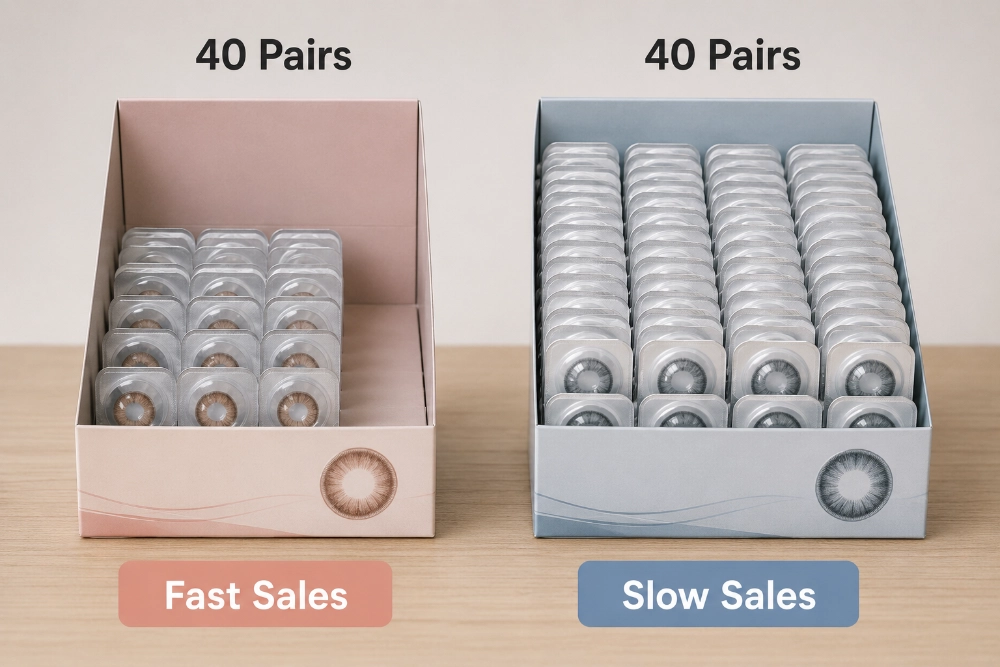
Forty pairs can represent an urgent inventory problem or months of stock.
It depends on how quickly those pairs leave.
| SKU | Current Stock | Average Weekly Sales | Approx. Stock Coverage |
|---|---|---|---|
| SKU A | 40 pairs | 10 pairs/week | 4 weeks |
| SKU B | 40 pairs | 2 pairs/week | 20 weeks |
The stock quantity is identical.
The commercial situation is completely different.
That is why rules such as:
Reorder every SKU when it reaches 30 pairs.
are rarely useful across an entire assortment.
A better starting point is stock coverage:
Stock Coverage = Current Inventory ÷ Average Sales Rate
For most distributors, this does not require sophisticated software. Weekly sales and current inventory are enough to create a useful first view.
For example:
- 60 pairs selling at 15 pairs per week = about 4 weeks of coverage
- 25 pairs selling at 2 pairs per week = more than 12 weeks
- 100 pairs selling at 5 pairs per week = about 20 weeks
The product with the most units in the warehouse can still be the one that needs attention first.
This is also where reorder timing differs from the earlier decision about whether a style deserves replenishment at all.
A strong SKU may clearly deserve another order and still have enough coverage that no action is required today.
A weak SKU may be physically low in stock but no longer justify another purchase.
Once the answer to “Should we reorder it?” is yes, stock coverage tells you how much time you have left.
Your Reorder Point Begins with Replenishment Lead Time
Consider a natural brown SKU selling eight pairs per week.
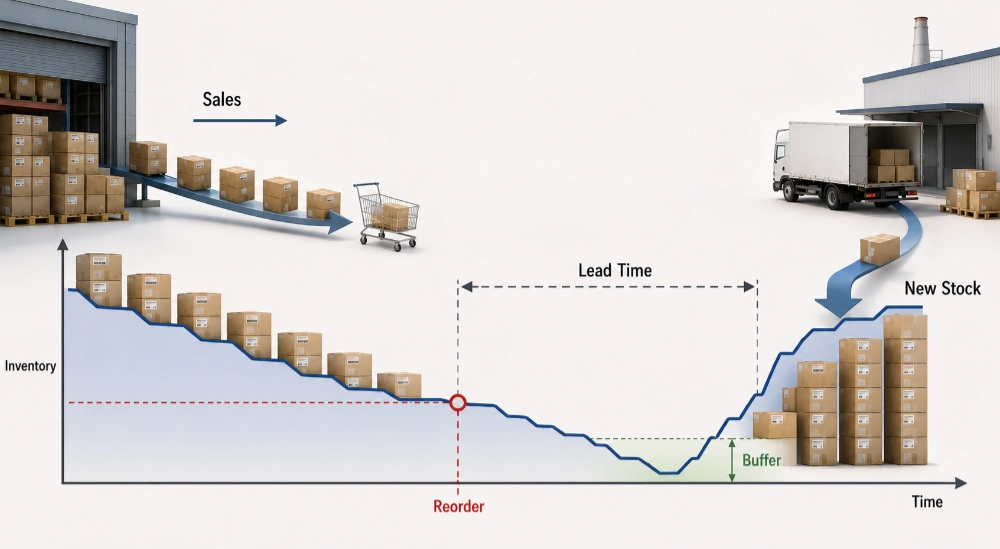
If new inventory takes three weeks to become available after you reorder, expected sales during that period are:
8 × 3 = 24 pairs
Those 24 pairs are not safety stock.
They are simply the inventory your business expects to consume while waiting.
That leads to a practical framework:
Reorder Point = Expected Demand During Replenishment + Safety Stock
The arithmetic is simple.
Getting the lead time right is more important.
Many sellers look only at shipping time. But replacement inventory may pass through several stages before it becomes sellable:
- order confirmation;
- stock allocation;
- packing;
- dispatch;
- transportation;
- customs or local handling where applicable;
- warehouse receiving;
- stock becoming available for sale.
If transit takes five days but the full process normally takes two weeks, your inventory needs to cover two weeks—not five days.
The more useful question is:
How long from placing the reorder until those pairs can actually be sold again?
Suppose a SKU sells 12 pairs per week and usable replacement inventory normally takes 2.5 weeks to arrive.
Expected demand during replenishment is approximately:
12 × 2.5 = 30 pairs
Waiting until the SKU reaches 15 pairs would mean your plan already depends on sales slowing down or replenishment arriving unusually early.
Neither is much of a plan.
Regional inventory can change this calculation. This is the same operational advantage discussed in our guide to how local warehouses help colored contact lens sellers restock faster in Southeast Asia.
For distributors operating in Southeast Asia, replacement stock does not always need to follow the same replenishment path. Inventory held closer to the destination market can shorten the time between reorder and usable stock, which in turn can reduce how much inventory a seller needs to protect locally.
UYAAI currently supports regional inventory and replenishment through self-operated warehouses in Vietnam, Indonesia, Malaysia, and Thailand, with additional third-party support in other markets. That does not eliminate stockout risk, but it can change the replenishment window a distributor needs to plan around.
Safety Stock Should Protect Against Variability, Not Fear
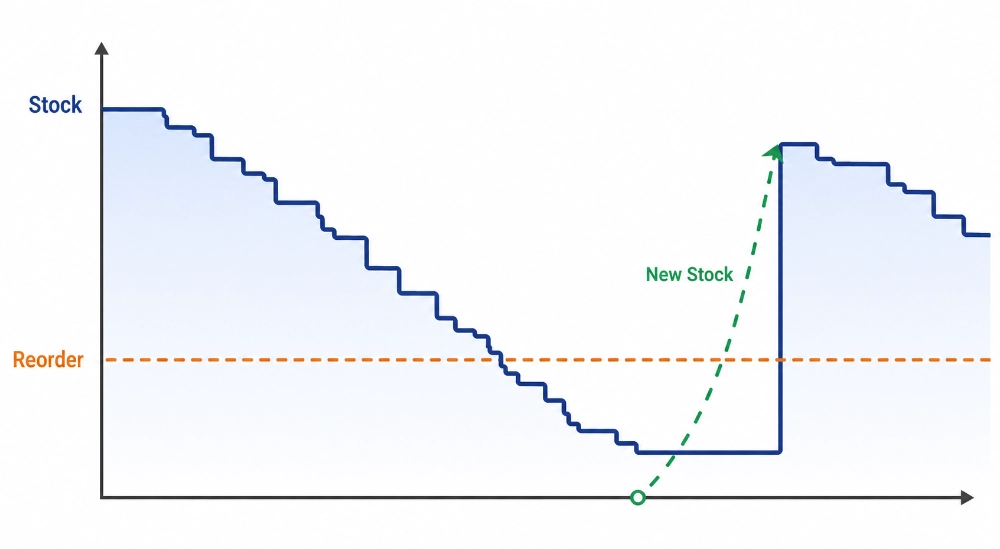
Lead-time demand covers what you expect to sell.
Safety stock covers what may not go exactly as expected.
That could mean:
- a stronger sales week;
- several resellers ordering at once;
- an unexpected promotion effect;
- a temporary dispatch delay;
- transportation taking longer than usual.
The easiest response is simply to hold more inventory.
But every extra pair has a cost.
A core SKU with stable repeat demand may justify a meaningful buffer because a stockout interrupts recurring business.
A new test SKU is different.
Imagine two products.
The first sells steadily across your ecommerce store and several reseller accounts. You have months of sales history and customers repeatedly ask for it.
The second is a new blue style that has sold a few pairs after launch.
Both may remain active.
Only one has enough evidence to justify deeper protection against a stockout.
This is why there is no useful universal rule such as:
Keep 20% extra inventory for every SKU.
A fixed percentage ignores the commercial role of the product, the reliability of demand, and the speed of replenishment.
Safety stock is not inventory held for psychological comfort.
It is inventory held against measurable uncertainty.
Do Not Give Every SKU the Same Reorder Point
A colored contact lens collection usually contains products with very different jobs.
Core SKUs
These are supported by clear demand evidence.
They may have:
- consistent weekly movement;
- repeat orders;
- importance across several channels;
- predictable customer demand.
These products normally deserve earlier attention because being unavailable can interrupt established sales.
Coverage SKUs
Some products are worth carrying because they complete the assortment rather than because they lead sales.
They may add:
- another color;
- another visual effect;
- another style role;
- more customer choice.
They can remain commercially useful without requiring the same stock depth as the strongest core products.
Test SKUs
A test should remain a test until demand proves otherwise.
If a new SKU receives a few early orders and the distributor immediately rebuilds deep stock behind it, the business has stopped testing demand and started betting on it.
That is an important distinction.
An active SKU does not automatically deserve an aggressive reorder point.
The role of each product inside the collection should affect how early it is reordered and how much buffer sits behind it.
This is also why building a balanced colored contact lens collection does not mean giving every SKU equal inventory. Different product roles require different levels of capital commitment.
Reorder Points Need to Move with the Business
Suppose a SKU originally sells five pairs per week.
Its reorder point is built around that demand and a four-week replenishment period.
Then the product is added to another marketplace and weekly sales rise to nine pairs.
The supply side has not changed.
The inventory risk has.
Keeping the old reorder point means the business waits just as long to react while inventory disappears almost twice as fast.
The reverse happens too.
If sales fall from nine pairs per week to three but the old reorder settings remain in place, stock continues arriving for a level of demand that no longer exists.
This is how a sensible safety buffer slowly becomes excess inventory.
Recheck the assumptions when something meaningful changes:
- sales accelerate;
- demand declines;
- a new channel begins selling the SKU;
- a large reseller starts or stops buying;
- replenishment becomes faster;
- lead time becomes less predictable;
- regional inventory becomes available;
- a test product becomes a proven core seller.
Fast-moving SKUs deserve closer review than slow ones.
You do not need to recalculate every product every day.
But the reorder point should move when either demand or replenishment moves.
Build a Simple SKU Reorder Sheet
A distributor can manage this with a spreadsheet before investing in a more advanced inventory system.
| SKU | Weekly Sales | Current Stock | Coverage | Lead Time | Reorder Point | Action |
|---|---|---|---|---|---|---|
| Natural Brown A | 10 | 38 | 3.8 weeks | 3 weeks | 35 | Reorder |
| Soft Gray B | 4 | 30 | 7.5 weeks | 3 weeks | 16 | Hold |
| Test Blue C | 1 | 16 | 16 weeks | 3 weeks | — | Monitor |
The exact figures will differ by business.
The value of the sheet is the questions it forces you to answer.
Instead of:
Does this stock level look low?
you ask:
How many weeks of sales remain?
How long will replacement stock take?
How much uncertainty actually needs a buffer?
For your fastest-moving SKUs, review the sheet weekly.
Slower products may need less frequent attention.
A significant change in demand or supply should trigger another review regardless of the schedule.
The distinction between Hold and Monitor matters as well.
A proven SKU with adequate coverage may require no action today.
A test SKU with 16 weeks of stock should not be automatically scheduled for another order simply because its quantity is eventually declining.
Demand still needs to earn the next inventory commitment.
That is where reorder planning stops being warehouse administration and becomes working-capital management.
The Goal Is Not Maximum Stock Availability
A distributor can make stockouts less likely by holding more inventory.
Taken far enough, that strategy creates a different problem.
More SKUs receive deeper buffers.
Orders are placed earlier.
Working capital stays inside the warehouse longer.
The real objective is not to make a stockout mathematically impossible.
It is to manage the tradeoff between two expensive mistakes.
Order too late:
- missed sales;
- interrupted repeat purchasing;
- unavailable core SKUs.
Order too early:
- unnecessary stock;
- slower inventory turnover;
- more capital committed before it is needed.
The best reorder point sits between them.
It gives replacement inventory enough time to arrive before existing coverage becomes unsafe, without funding the next shipment earlier than the business can justify.
For distributors managing more than one market, reorder timing should also fit the wider inventory plan across Southeast Asian markets, because the same SKU may require different stock depth in different locations.UYAAI’s branded wholesale model includes a 100-pair minimum order and a 5-pair minimum per SKU, alongside regional inventory support in key Southeast Asian markets.
If you are preparing your next reorder, start with four pieces of information:
- your market;
- your main sales channel;
- the SKUs you currently carry;
- your approximate replenishment requirement.
That creates a much better basis for discussing available products and the next order than simply waiting until stock looks low.
View the UYAAI Wholesale Catalog to review available product directions, or Submit a Wholesale Inquiry to discuss your next replenishment plan.
The best reorder point protects the next sale without overfunding the next shipment.