
Managing colored contact lens inventory becomes more complicated when a business expands beyond one market.
A distributor may sell the same collection in Vietnam, Indonesia, Malaysia, Thailand, or other Southeast Asian markets. But that does not mean every location needs the same number of SKUs, the same quantity per SKU, or the same reorder schedule.
Copying one inventory plan across every market may look efficient. In practice, it can leave one location short of proven sellers while another holds too much slow-moving stock.
The better principle is simple:
Keep the portfolio consistent where useful. Change inventory depth according to demand and replenishment conditions.
The question is no longer only what should we sell?
It becomes:
How much of each product should we keep in each market?
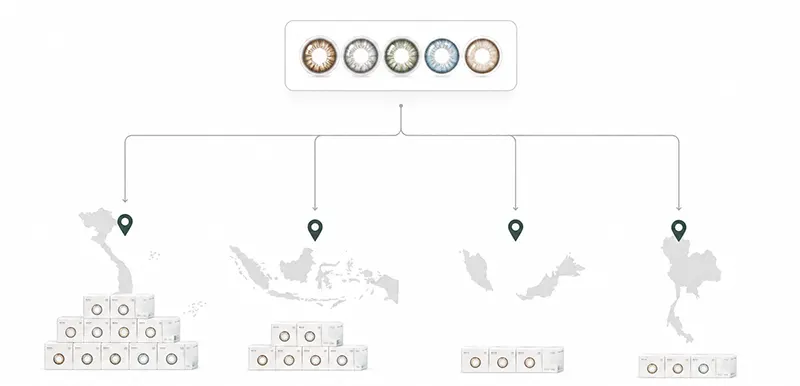
Separate Product Portfolio from Inventory Depth
Product portfolio and inventory depth solve two different problems.
Your product portfolio defines what the business is prepared to sell: core styles, differentiated products, test products, replacement-cycle options, and products suited to different sales channels.
Inventory depth determines how much of each product a particular market should actually hold.
That distinction matters.
A natural brown lens might remain part of the regional portfolio because it serves an important commercial role. One market may justify deeper local stock because demand is already proven. Another may need only a small testing quantity. A third may not need permanent local depth at all if replenishment is practical.
You do not need to redesign the entire collection every time one market behaves differently.
In many cases, the first adjustment should be stock depth, not product selection.
If you are still deciding which commercial roles different styles should play, start with our guide to How to Build a Balanced Colored Contact Lens Collection That Actually Sells before allocating inventory market by market.
Keep Core Stock Separate from Test Stock
Not every SKU deserves the same inventory commitment.
A useful starting point is to divide stock into two broad roles:
| Inventory Type | Main Role |
|---|---|
| Core Stock | Keep products with proven recurring demand available |
| Test Stock | Measure demand before committing deeper inventory |
Core stock earns its position through evidence. A product that sells consistently, generates repeat demand, and remains important to the local assortment deserves closer stockout monitoring and more reliable replenishment.
Test stock has a different job.
When entering a new market, adding a new style, or testing another sales channel, the goal should not be maximum opening availability. The goal is to learn whether demand deserves a larger commitment.
This is also where smaller, flexible opening orders can be useful. UYAAI’s standard branded wholesale structure starts from 100 pairs per order with a minimum of 5 pairs per SKU, allowing buyers to spread an initial order across multiple products rather than committing heavily to one unproven style. These minimums apply to standard branded wholesale rather than private-label projects.
For a more detailed first-market approach, see How to Test a Colored Contact Lens Market with Only 100 Pairs.
Once demand becomes visible, however, the question changes again.
A product may deserve deeper stock—but how deep?
Set Stock Depth Using Demand and Replenishment
Sales volume alone should not decide inventory depth.
A more useful decision combines two factors:
Demand + Replenishment Risk
This is a management principle, not a fixed mathematical formula.
Consider four common situations.
High Demand + Slow Replenishment
This is where deeper inventory is easiest to justify.
If a product sells consistently but takes longer to replace, holding too little stock increases the risk of losing sales before the next shipment arrives.
High Demand + Fast Replenishment
High demand does not always require maximum local inventory.
When a proven SKU can be replenished reliably and relatively quickly, a distributor may be able to operate with leaner stock while still maintaining availability.
This is why replenishment infrastructure matters.
For example, UYAAI currently operates its own warehouses in Vietnam, Indonesia, Malaysia, and Thailand. Local or regional stock can give distributors more replenishment options, although actual SKU availability and fulfillment conditions still need to be confirmed for each order.
A distributor with access to replenishment support may therefore make a different inventory decision from one importing every repeat order through a longer supply chain.
Low Demand + Slow Replenishment
This combination requires caution.
Slow replenishment may tempt a buyer to hold more safety stock, but weak demand makes that stock more likely to sit unsold.
Instead of automatically increasing inventory, ask whether the SKU really needs permanent local availability.
Low Demand + Fast Replenishment
This is often the easiest situation in which to keep local stock light.
The product can remain available in the portfolio without consuming much working capital in every market.
The important point is that two markets with identical sales can still require different inventory depth if replenishment conditions are different.
Use Real Sales Signals, Not Assumptions
Demand should come from what your business is actually seeing.
Useful indicators include:
- Sales velocity
- Sell-through
- Repeat demand
- Stockout frequency
There is no need to create a complicated forecasting model for every SKU. You are looking for enough evidence to distinguish recurring demand from temporary activity.
A product that sold quickly after one viral post should not automatically receive the same inventory treatment as a product that has sold consistently for several reorder cycles.
Likewise, do not assume that a style needs deeper inventory simply because it performs well in another Southeast Asian market.
Measure first.
Our guide to How to Use Sales Data to Decide Which Colored Contact Lens Styles to Restock covers the underlying sales signals in more detail.
And when replenishment speed is the limiting factor, How Local Warehouses Help Colored Contact Lens Sellers Restock Faster in Southeast Asia explains why stock location can change the amount of inventory a seller needs to hold.
Let Inventory Depth Change as the Market Develops
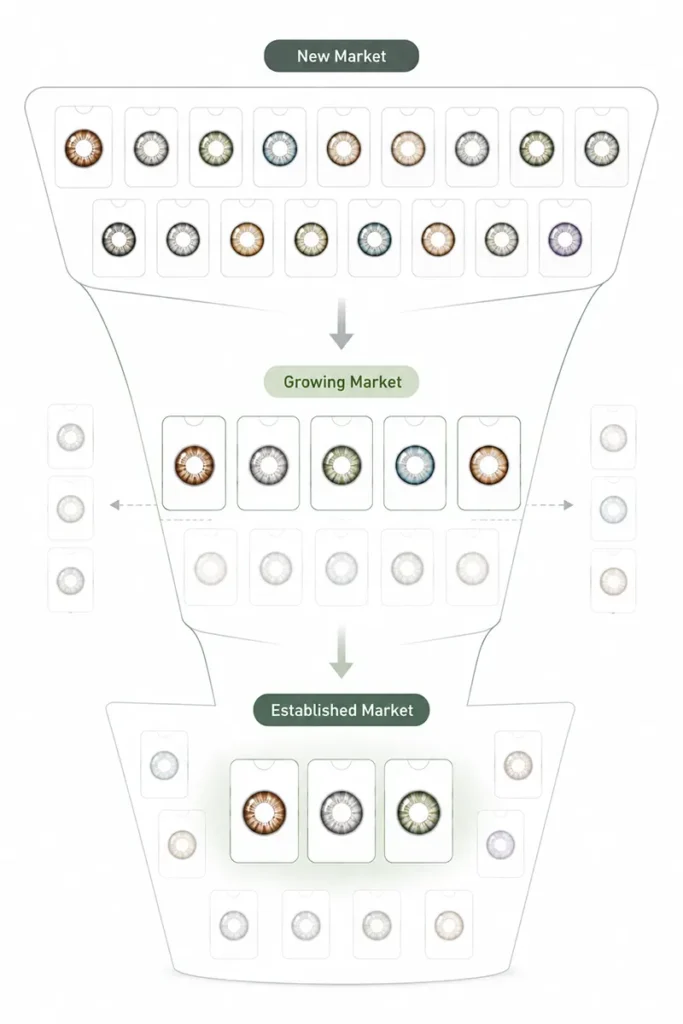
A market that is new to your business should not be stocked like one you have served successfully for two years.
The difference is not whether one country is a “better” colored contact lens market than another. It is how much your own business knows about demand there.
A new market is primarily a learning environment. Keep test quantities controlled, watch which SKUs gain traction, and avoid building deep inventory around assumptions.
As demand becomes more predictable, proven products can gradually move into core stock.
By the time a market is established, the challenge often changes again. The business may already know what sells; now it needs to maintain availability without allowing years of accumulated SKU decisions to create unnecessary inventory.
Mature markets often carry the most stock—and therefore have the most to lose from inventory habits nobody has reviewed for six months.
Manage Inventory Regionally Before Ordering More
Once several markets are active, managing each country as a completely isolated inventory system can become expensive.
You need two views at the same time.
The market view asks:
- What is selling here?
- What is running low?
- Which products are repeatedly unavailable?
The regional view asks something different:
- Where is inventory sitting across the entire business?
- Are the same slow products being duplicated in several locations?
- Can existing stock support another market?
- Does the business actually need to reorder?
That last question is easy to overlook.
Imagine four markets independently carrying local depth in Natural Brown, Grey, Big Eye, Soft Glam, and several test styles.
Each market may look reasonable when viewed separately.
Regionally, however, the business could be holding four sets of slow-moving inventory simply because every location was planned as a standalone operation.
A more structured system can divide inventory into three levels:
| Inventory Level | Role |
|---|---|
| Local Core Stock | Proven repeat sellers that benefit from immediate availability |
| Regional Support Stock | Products that can support several markets without deep local stock everywhere |
| Test / Order-Driven Stock | Newer or lower-volume products with limited inventory commitment |
This does not mean every SKU can be freely moved between countries. Local regulations, product approvals, logistics, labeling, and operational requirements still need to be considered.
The principle is about visibility.
Before increasing total inventory, understand what the business already owns and where it is located.
Regional expansion should increase inventory intelligence faster than it increases inventory volume.
Sometimes the correct response to a stock problem is a new wholesale order.
Sometimes it is not.
Use a Simple Regional Inventory Review Cycle
A regional inventory review does not need to become a complicated forecasting exercise.
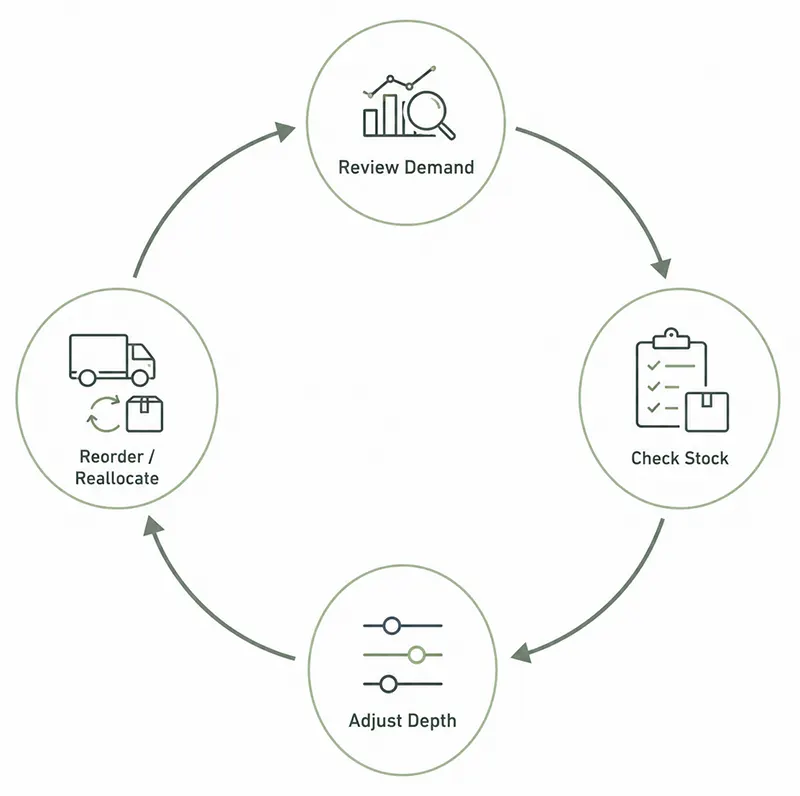
Start with four questions:
1. Review Demand
Which SKUs are actually moving in each market?
2. Check Stock
Where is the inventory currently sitting?
3. Adjust Depth
Which products need more local stock, less stock, or continued testing?
4. Reorder or Reallocate
Does the business need more inventory, or can existing stock solve the problem?
This creates a much better operating habit than treating every low-stock notification as an automatic purchase signal.
A fast-selling SKU may need another order.
A slow SKU may need less inventory.
One market may need stock that another market already has too much of.
The objective is not simply to reorder efficiently. It is to make the right inventory decision before ordering.
When Multi-Market Growth Needs a More Structured Wholesale Plan
Inventory management usually becomes more demanding when:
- the same SKUs are being reordered repeatedly;
- stock is held in several countries;
- one market experiences stockouts while another holds excess inventory;
- markets operate on different replenishment cycles;
- the total SKU count becomes difficult to monitor;
- regional order volume continues to increase.
At this stage, the business is no longer simply choosing colored contact lens styles.
It is managing a regional distribution system.
Supplier stock visibility, replenishment support, local or regional inventory, and predictable repeat-order availability therefore become more important than they were during the first market test.
For distributors serving Southeast Asia, UYAAI’s wholesale model is built around branded distribution, flexible assortment planning, and regional inventory and restocking support. Buyers can review the Wholesale Catalog first to identify relevant products and then discuss availability according to the markets they actually serve.
Plan Your Southeast Asia Wholesale Inventory
Managing colored contact lens stock across more than one Southeast Asian market?
Tell us the countries you serve, your sales channels, current best-selling SKUs, and approximate reorder volume. The UYAAI wholesale team can help you review product availability and regional restocking options.
Regional Growth Does Not Automatically Require More Stock
The same colored contact lens portfolio can serve several Southeast Asian markets without carrying the same inventory depth everywhere.
Keep proven products available. Test uncertain demand carefully. Increase depth where sales justify it, and consider replenishment conditions before adding safety stock.
Most importantly, look at inventory both locally and regionally before placing another order.
The goal is not maximum stock.
It is the right inventory, in the right market, with a realistic path to replenishment.