
Adding more products does not automatically make a colored contact lens collection stronger.
A distributor may carry dozens of brown and grey lenses yet still offer customers very little meaningful choice. Product names may differ, but when several lenses create similar on-eye results, target the same customer, and compete for the same inventory budget, the collection becomes larger without becoming more useful.
This often leads to:
- Sales being divided across similar SKUs
- Slow-moving stock consuming restocking capital
- Customers struggling to understand product differences
- Repetitive store displays and social content
- Best sellers running out while money remains tied up elsewhere
A balanced collection is not built by giving every lens style equal space. It is built by giving every product a clear commercial role.
This guide explains how colored contact lens distributors, beauty retailers, optical stores, and ecommerce sellers can build an assortment that supports stable sales, visual variety, controlled testing, and repeat purchasing.
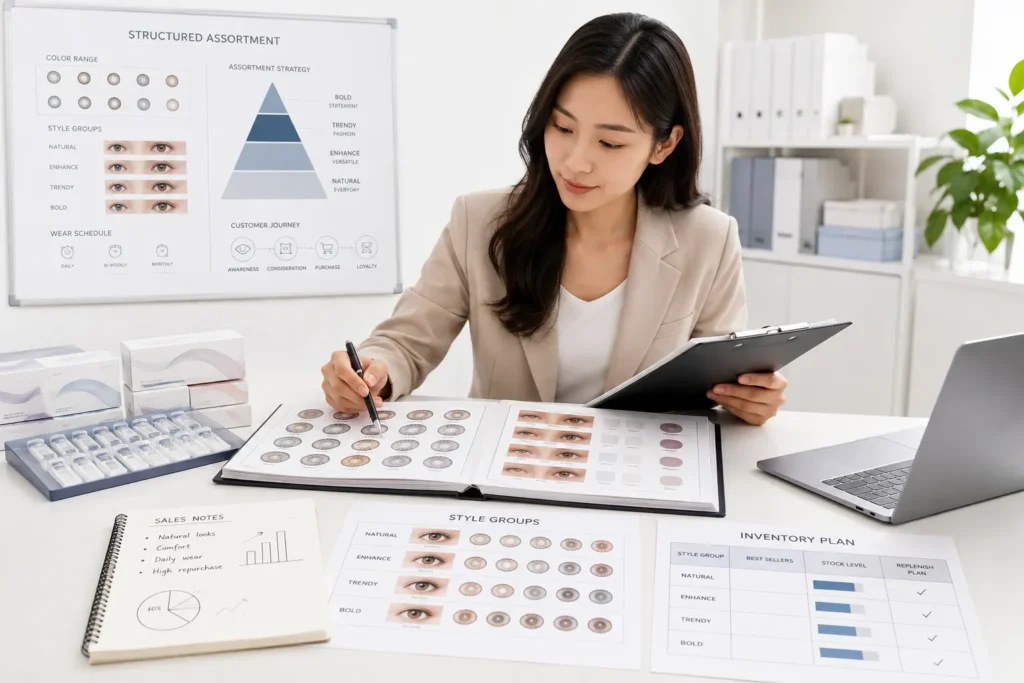
Start With Customer Needs, Not Individual Colors
Many product selections begin with a simple reaction:
This brown looks attractive. That grey also looks attractive. Let us stock both.
That approach becomes risky as the catalog grows.
The better starting point is not the color itself. It is the reason a customer would choose the product.
| Customer need | Product role |
|---|---|
| Subtle daily enhancement | Reliable everyday seller |
| A more polished makeup effect | Versatile beauty option |
| Visible eye enlargement | Clear transformation style |
| Additional depth and dimension | Distinctive mid-level option |
| Strong color or contrast | Social-content product |
| A soft, airy finish | Trend-led style |
Color alone does not define the result.
A brown lens may be Natural, Big Eye, Soft Glam, or Bold Hybrid depending on its outer ring, opacity, pattern, contrast, and graphic diameter. Two grey lenses may also serve completely different buyers.
When inventory is organized only by color, sellers often purchase several products that perform the same job. Organizing by customer need makes assortment gaps and unnecessary overlap much easier to see.
Give Each Lens Style a Clear Job
UYAAI organizes its colored contact lens range into six style groups:
- Natural
- Big Eye
- Soft Glam
- Soft Hybrid
- Bold Hybrid
- K-Beauty
These groups are not a formula requiring the same number of SKUs in every category. They help distributors understand what each product contributes to the collection.
Natural: Build the Stable Base
Natural styles suit daily wear, first-time buyers, and customers who prefer a subtle result. They can provide steady demand and repeat purchasing.
However, too many similar natural browns and greys create apparent variety without meaningful choice.
Use Natural as the base of the collection—not the entire collection.
Soft Glam: Offer an Everyday Upgrade
Soft Glam adds more visible color and definition while remaining wearable for daily makeup.
It is useful for customers who find Natural too subtle but do not want a dramatic transformation. For many beauty shops and ecommerce channels, it can serve as the mainstream upgrade category between quiet daily styles and more obvious effects.
Big Eye: Meet a Specific Enlargement Need
Big Eye should represent a clear transformation category.
Defined outer rings and larger graphic diameters can make the eyes appear rounder, brighter, and more youthful. This appeals to customers actively seeking an enlarging effect.
The commercial mistake is treating every dark-ring lens as Big Eye. The product should create a visibly different result and serve a customer preference that the rest of the collection does not already satisfy.
Soft Hybrid: Add Wearable Differentiation
Soft Hybrid gives customers more depth through ash brown, olive, grey, and muted multi-tone effects without becoming highly dramatic.
Its role is simple:
Differentiation without excessive risk.
It works particularly well when a collection moves too abruptly from subtle Natural designs to high-contrast transformation styles.
Bold Hybrid: Create Attention
Bold Hybrid products are designed to be noticed.
They can support:
- Full makeup looks
- Fashion photography
- Influencer content
- Short-form video
- Customers seeking a strong transformation
Their value should not be measured only by unit sales. A visually strong product may generate clicks, comments, and store interest even when it sells in smaller quantities than a Natural or Soft Glam lens.
That makes it valuable—but not necessarily suitable for deep inventory.
K-Beauty: Add a Soft Trend-Led Option
K-Beauty styles typically use lower-saturation colors, delicate patterns, and soft edges to create a clean, translucent effect.
They should not be grouped automatically with Natural products.
Natural aims to blend closely with the existing iris. K-Beauty may remain soft and wearable, but it expresses a more specific aesthetic: airy, refined, and softly focused.
Do Not Give Every Style the Same Inventory Weight
A balanced collection is not an evenly divided collection.
Carrying six style groups does not mean allocating one-sixth of inventory to each. The correct weight depends on:
- Sales channel
- Customer preferences
- Existing sales history
- Content strategy
- Restocking speed
- Inventory risk
A beauty shop serving everyday customers may need a stronger Natural and Soft Glam base. A social seller producing high-impact videos may keep more Big Eye and Bold Hybrid options. An optical store may place greater emphasis on wearable styles and clear product differentiation.
A practical starting structure may look like this:
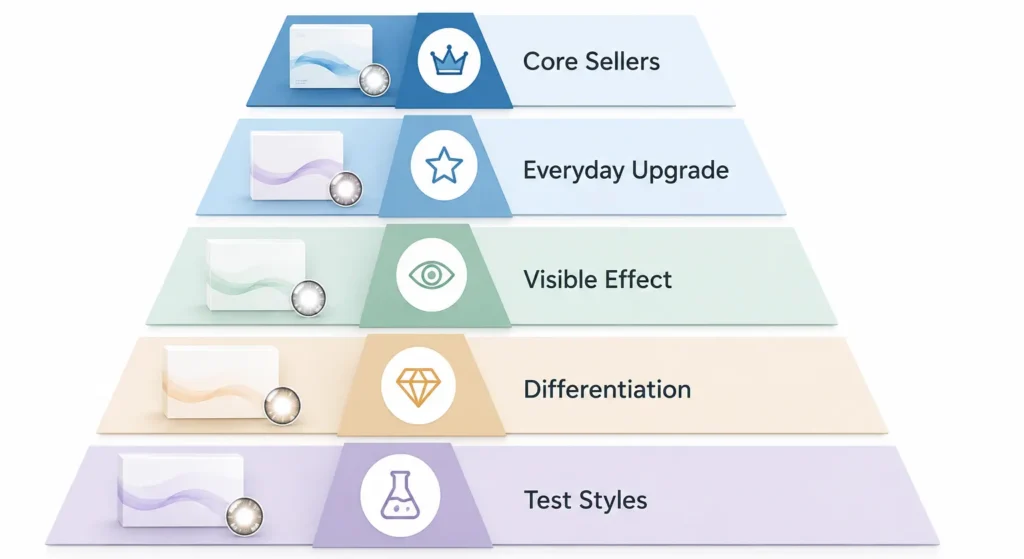
| Collection role | Inventory weight | Main purpose |
|---|---|---|
| Core daily sellers | High | Stable demand and repeat sales |
| Polished everyday styles | Medium to high | Mainstream beauty demand |
| Enlargement styles | Medium | Specific visible-effect demand |
| Dimensional styles | Medium | Product differentiation |
| High-impact styles | Controlled | Social content and discovery |
| Trend-led test styles | Small test | Demand validation |
This is a planning framework, not a universal formula.
A distributor with reliable sales history should use its own results. A new seller should treat the structure as a starting hypothesis and adjust it after observing actual demand.
Balance Style, Color, and Replacement Cycle Separately
A collection can look balanced in one dimension while remaining weak in another.
A seller may carry all six style groups but still have too many grey lenses. Another may offer a wide range of colors but only one replacement cycle.
Review these three decisions separately.
Style Balance
Does the assortment include genuinely different outcomes?
For example:
- Subtle enhancement
- Polished daily beauty
- Visible enlargement
- Soft dimensional effects
- Strong transformation
- Airy trend-led looks
The objective is not to fill categories mechanically. It is to serve more than one buying motivation.
Color Balance
Count colors, but compare the on-eye results as well.
Five brown SKUs are not necessarily excessive when each one serves a different role. They become excessive when customers, store staff, or online viewers cannot clearly distinguish them.
The same test applies to grey, green, blue, and special colors.
Replacement-Cycle Balance
Monthly and half-year products create different purchasing patterns.
Consider:
- Customer buying habits
- Price sensitivity
- Expected repurchase cycle
- Store positioning
- Restocking frequency
- Available SKU capacity
A distributor does not need to offer every design in every replacement cycle. Doing so may duplicate the collection without adding meaningful choice.
Separate Core Sellers From Attention Products
One of the most common assortment mistakes is expecting every SKU to become a bestseller.
Products can create value in different ways.
| Product role | Main job |
|---|---|
| Core seller | Produce steady sales |
| Repeat seller | Support predictable reorders |
| Attention product | Generate clicks, views, or store interest |
| Differentiation product | Prevent the collection from looking generic |
| Test product | Validate emerging demand |
| Seasonal product | Support campaigns or limited periods |
A Natural brown may produce modest social content but sell steadily for months.
A Bold Hybrid green may generate more comments and video views while selling in smaller quantities.
Both can deserve a place in the assortment.
Evaluate products by the job they perform, not by expecting every SKU to become a bestseller.
Core sellers need stronger availability and earlier restocking. Attention products may need fewer units but better images and videos. Test products should remain controlled until demand becomes clear.
Remove Overlap Before Adding More SKUs
When sales slow down, adding new products can feel like the obvious response.
Sometimes the real problem is too much repetition.
Before expanding the catalog, compare similar products and ask:
- Do they create visibly different on-eye results?
- Do they serve different customer groups?
- Do they suit different sales channels?
- Does one perform better in photos or videos?
- Does one receive stronger repeat demand?
- Can staff clearly explain the difference?
- Would removing one reduce meaningful customer choice?
When most answers are no, the products may be competing for the same customer and the same inventory budget.
This often happens gradually. A distributor adds one new brown lens each season, keeps every older option, and eventually carries several designs with nearly identical effects.
Reducing overlap can:
- Concentrate sales on stronger SKUs
- Simplify product explanations
- Improve inventory visibility
- Release capital for restocking
- Create room for genuinely different styles
Use Small Test Quantities for New Collection Roles
Identifying an assortment gap does not mean placing a deep order immediately.
Suppose a distributor currently sells mainly Natural and Soft Glam products. The collection may lack:
- A clear Big Eye option
- A wearable Soft Hybrid style
- A visually strong Bold Hybrid design
- A small K-Beauty test group
A safer process is:
Identify the gap → Select test styles → Track results → Restock or replace
UYAAI’s branded wholesale structure currently starts from 100 pairs, with a minimum of 5 pairs per SKU. This allows qualifying buyers to test several styles without committing heavily to one unproven design.
The purpose is not to maximize the number of SKUs. It is to collect useful information.
Track signals such as:
- Product page views
- Customer questions
- Saved or shared posts
- Initial sales
- Repeat demand
- Color preferences
- Requests for similar effects
For a broader testing process, see How to Test a Colored Contact Lens Market with Only 100 Pairs. Sellers building their initial assortment can also refer to How to Choose Your First 10 Lens Styles Without Overstocking.
Review the Collection With Sales Data
Personal taste can help identify attractive products, but it should not control the assortment.
A lens that looks impressive to the buyer may not suit the store’s main customer group. A design that appears ordinary in the catalog may become a reliable repeat seller.
| Signal | Possible action |
|---|---|
| Strong sales and repeat orders | Increase restocking priority |
| Strong views but weak sales | Review content, price, or market fit |
| Low sales with clear differentiation | Keep as a controlled niche product |
| Low sales with high overlap | Reduce or replace |
| Frequent stockouts | Reorder earlier or increase safety stock |
| New style gaining traction | Expand gradually |
| Sales only during promotions | Review permanent stock status |
Not every product should be judged after a few weeks. Some styles need better photography, video, product explanation, or customer education.
But products should not remain indefinitely without a reason.
Each SKU should earn its position through sales, repeat demand, differentiation, content value, or another clearly defined role.
Restocking Is Part of Product Selection
A product may perform well during the first order but become difficult to reorder when customers return.
Before giving a style a major role in the collection, confirm:
- Whether it is actively supplied
- Whether stock information is clear
- How quickly repeat orders can be processed
- Whether regional inventory is available
- Whether suitable alternatives exist
UYAAI operates self-managed warehouses in Vietnam, Indonesia, Malaysia, and Thailand to support regional inventory and restocking. Availability and delivery conditions should still be confirmed for each product, order, and destination.
The guide How Local Warehouses Help Colored Contact Lens Sellers Restock Faster in Southeast Asia explains why replenishment planning should begin before a bestseller runs out.
A collection that sells but cannot be restocked is not balanced. It is temporarily successful.
A Practical Collection Review Framework
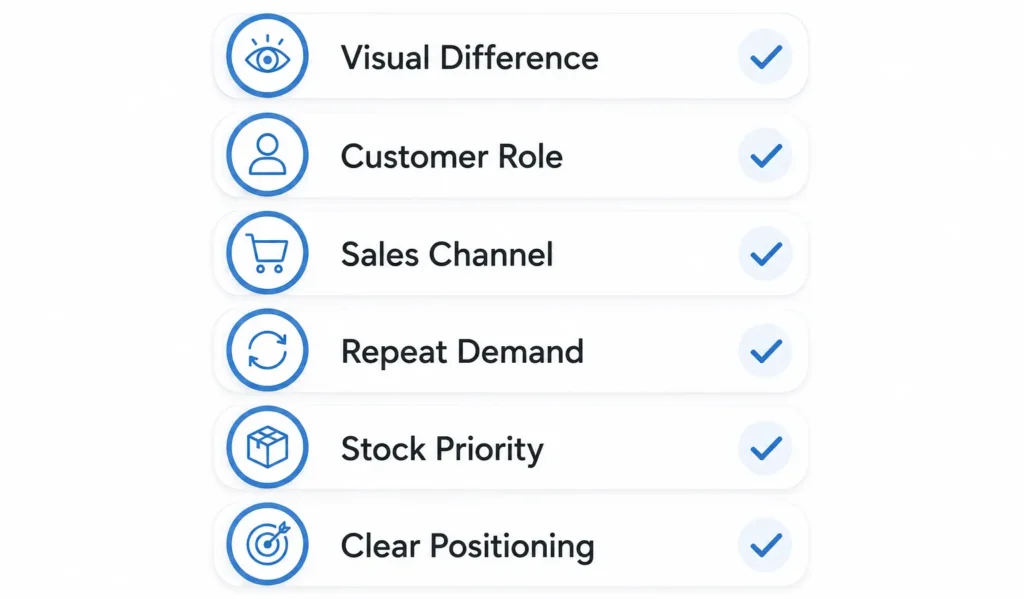
Use these five questions:
- Does every product serve a clear customer need?
- Are too many SKUs producing nearly the same result?
- Do core sellers receive more inventory than test styles?
- Can the collection support both stable sales and visual discovery?
- Can successful products be restocked reliably?
There is no universal ideal number of styles.
A strong collection is broad enough to serve different buying motivations, but focused enough that every SKU earns its place.
Build a Product Mix for Your Market
Browse the UYAAI wholesale catalog to compare Natural, Big Eye, Soft Glam, Soft Hybrid, Bold Hybrid, and K-Beauty styles.
When reviewing products, consider the role each lens would play in your collection—not only whether the color looks attractive on its own.
Tell the UYAAI wholesale team your country, sales channel, current assortment, and intended order size if you need help identifying product gaps or selecting styles for controlled testing.