
Many colored contact lens sellers focus only on product price when choosing a supplier.
But after the first order, a different problem appears:
What happens when your best-selling styles sell out faster than expected?
For sellers in Southeast Asia, restocking speed can directly affect sales. If customers are asking for a popular brown, grey, or big eye style and you cannot restock quickly, they may buy from another seller.
That is why local warehouse support matters.
A good warehouse system does not just move products. It helps sellers reduce waiting time, avoid over-ordering, and keep fast-moving SKUs available.
Restocking Is Where Many New Sellers Lose Momentum
A first wholesale order helps you test the market.
But the second and third orders decide whether your business can grow.
Many new sellers face the same pattern:
| Situation | Problem |
|---|---|
| One style sells out quickly | Seller cannot restock fast enough |
| Slow styles remain in stock | Cash is stuck in inventory |
| Supplier delivery takes too long | Customer demand is lost |
| Seller orders too much next time | Overstock risk increases |
| Product demand changes quickly | Stock planning becomes harder |
This is especially common with colored contact lenses because demand is not always even.
One natural brown style may sell every week.
One grey style may perform well on TikTok.
One bright style may get attention but sell slowly.
Without faster restocking, sellers may feel forced to buy too much inventory “just in case.”
Why Local Warehouses Matter for Southeast Asian Sellers
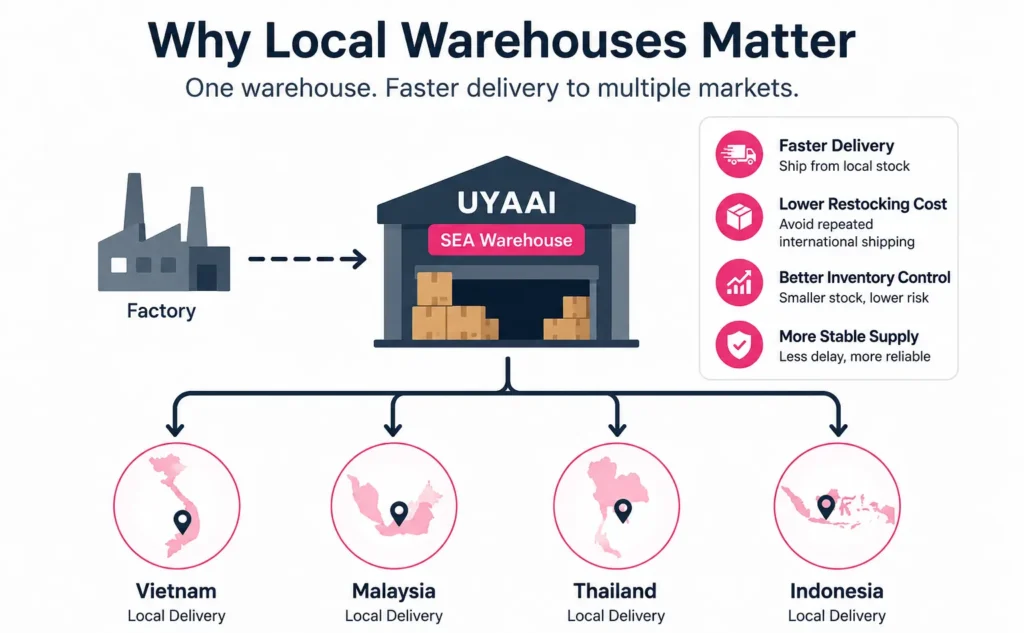
For Southeast Asian colored contact lens sellers, a local or regional warehouse can make inventory planning easier.
It can help with:
- shorter delivery time
- faster repeat orders
- better response to best-selling SKUs
- lower pressure to overstock
- easier market testing
- smoother reseller and shop supply
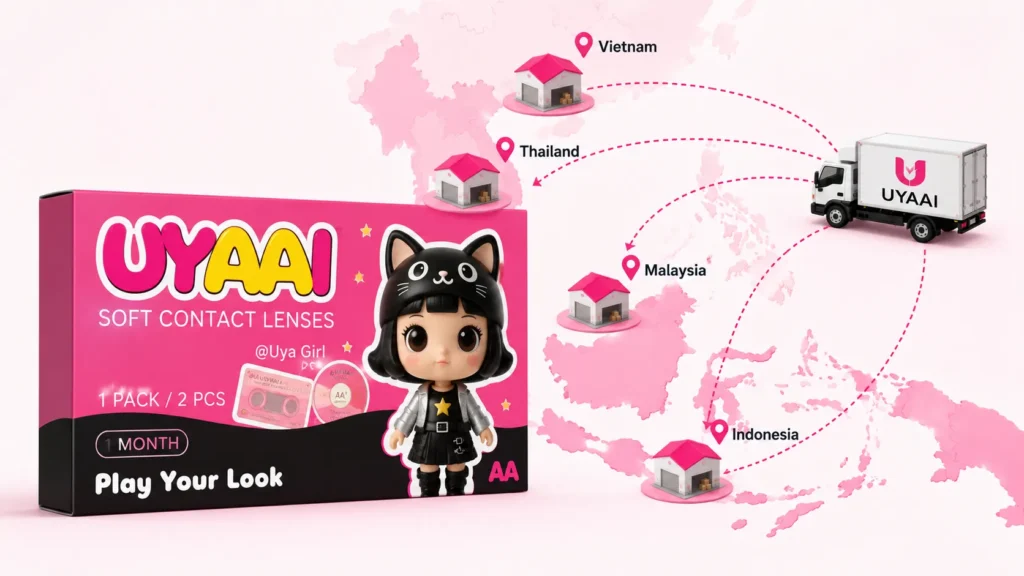
UYAAI supports Southeast Asian wholesale buyers with self-operated warehouses in:
- Vietnam
- Indonesia
- Malaysia
- Thailand
This gives qualified sellers more flexibility when planning repeat orders and local restocking.
Local Warehouses Help You Order Less Blindly
Without warehouse support, sellers often order based on fear.
They worry:
- What if delivery takes too long?
- What if my best style sells out?
- What if I cannot restock before the next campaign?
- What if customers ask for a color I no longer have?
This fear can lead to over-ordering.
With better restocking support, you can plan more carefully.
| Without Local Warehouse Support | With Local Warehouse Support |
|---|---|
| Order more stock to avoid delays | Start leaner and restock winners |
| Guess future demand | Test demand and reorder based on sales |
| High pressure on first order | More flexible repeat-order planning |
| Slow movers lock cash | Inventory can be adjusted over time |
| Delivery uncertainty | Better stock planning rhythm |
A local warehouse does not remove all risk, but it can reduce the pressure to make every decision in one large first order.
Step 1 — Use Your First Order to Test Demand
Your first order should not try to predict the whole market.
It should help you learn.
For UYAAI wholesale buyers, the starting MOQ is 100 pairs, with 5 pairs minimum per SKU. This allows new sellers to test a focused mix of styles before expanding.
A first order can help you understand:
- which colors sell fastest
- which styles get customer questions
- which products need better photos or videos
- which SKUs should be reordered
- which products should not be repeated
Local warehouse support becomes more valuable after this test, because you can restock based on real demand instead of guessing.
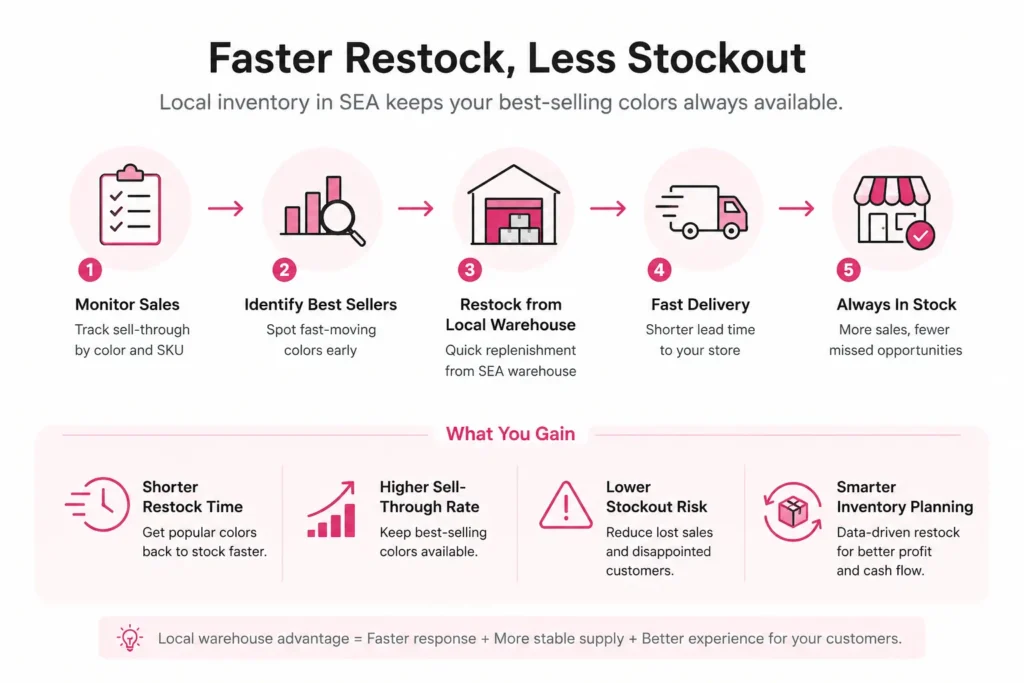
Step 2 — Track Fast-Moving SKUs Early
Restocking only works if you know what is selling.
Do not wait until everything is sold out to check your inventory.
Track sales weekly.
| SKU Type | What to Watch |
|---|---|
| Natural brown | Daily sales and repeat customer demand |
| Grey lenses | Online conversion and customer questions |
| Black / big eye styles | Beauty shop and TikTok response |
| Trend colors | High attention but possible slower repeat sales |
| Monthly lenses | Repeat purchase cycle |
| Half-year lenses | Longer wearing cycle and slower reorder timing |
After two to four weeks, you should already know which styles need closer restocking attention.
Step 3 — Separate Best-Sellers from Test Styles
Not every SKU deserves the same restocking plan.
A common mistake is treating every style equally.
Instead, divide your SKUs into three groups:
| SKU Group | Meaning | Restocking Action |
|---|---|---|
| Core sellers | Consistent demand | Keep available and restock early |
| Growth styles | Good potential but still testing | Reorder carefully |
| Slow movers | Weak sales or low repeat demand | Reduce or replace |
This helps you avoid restocking slow products just because they are already in your catalog.
Your goal is not to carry more SKUs.
Your goal is to carry the right SKUs.
Step 4 — Plan Restocking Before You Run Out
Many sellers reorder too late.
They wait until a style is almost gone, then contact the supplier. By the time the replacement stock arrives, demand has already moved elsewhere.
A better approach is to create a simple reorder point.
For example:
| Stock Level | Action |
|---|---|
| 10+ pairs left | Continue selling and tracking |
| 5–10 pairs left | Check recent sales speed |
| Under 5 pairs left | Prepare reorder if demand is strong |
| Sold out | Too late if the style is a regular seller |
For fast-moving colored contact lens styles, restocking should be planned before the product disappears from your store, shop, or online listing.
Step 5 — Use Local Warehouse Support for Repeat Orders
Local warehouse support is especially useful after your first sales cycle.
At that point, you know more about:
- which SKUs sold
- which colors moved slowly
- which customers returned
- which product photos worked
- which channels created demand
Your repeat order should not simply copy your first order.
It should:
- increase proven best-sellers
- reduce slow-moving styles
- add a few new test styles
- protect fast-moving inventory
- support upcoming campaigns or seasonal demand
This is where local warehouses can help sellers move from guessing to planning.
Step 6 — Match Warehouse Planning to Your Sales Channel
Different sales channels need different restocking rhythms.
| Sales Channel | Restocking Priority |
|---|---|
| Beauty shop | Keep natural daily-use colors available |
| Optical store | Avoid frequent stockouts of safe, wearable styles |
| TikTok seller | Restock viral or transformation styles quickly |
| Shopee / Lazada seller | Maintain listing availability and avoid out-of-stock pages |
| Distributor | Support downstream resellers with stable repeat supply |
| Wholesaler | Keep larger quantity of proven fast-moving SKUs |
If your main channel is online, stockouts can hurt listing performance.
If your main channel is offline retail, stockouts can break customer trust.
If you are a distributor, slow restocking can affect your entire reseller network.
Local Warehouses Do Not Replace SKU Planning
Warehouse support is powerful, but it does not fix poor product selection.
If a seller chooses too many weak styles, faster delivery will not solve the main problem.
A better system combines:
- focused first order
- weekly SKU tracking
- local warehouse support
- clear reorder points
- continuous product mix improvement
This is how colored contact lens sellers reduce inventory risk while still growing product variety over time.
A Simple Restocking Framework for New Sellers
Use this framework after your first wholesale order:
| Stage | What to Do |
|---|---|
| Week 1 | Track customer questions and first sales |
| Week 2 | Identify early fast-moving colors |
| Week 3 | Separate core sellers from test styles |
| Week 4 | Prepare repeat order plan |
| Month 2 | Restock winners and reduce slow movers |
| Month 3 | Expand only the styles with proven demand |
This approach helps you avoid two common problems:
- selling out of your best styles too soon
- buying too much stock before you understand demand
Restock Faster Without Overstocking
For Southeast Asian colored contact lens sellers, local warehouse support can be the difference between a one-time test order and a repeatable wholesale business.
It helps you respond faster when best-selling styles move, while reducing the pressure to over-order slow products.
UYAAI supports qualified wholesale buyers with 100 pairs MOQ, 5 pairs minimum per SKU, and warehouse support in Vietnam, Indonesia, Malaysia, and Thailand.
If you are planning to sell colored contact lenses in Southeast Asia, submit your country, sales channel, and order plan. UYAAI can help you choose a starter mix and plan a smarter restocking path.