
Alya runs an online colored contact lens business in Malaysia. By the end of last year, nothing looked seriously wrong.
Orders were still coming in. She had a broad assortment to sell. Her storage shelves were not overflowing.
Yet every time she prepared another wholesale order, the available buying cash felt tighter than she expected.
Natural Brown was running low. Soft Gray moved more slowly, but customers still bought it regularly. Big Eye Brown had performed well earlier in the year, so Alya had ordered more heavily when she replenished it. Months later, much of that inventory was still there.
She had also recently added Mist Gray. Early sales looked encouraging, but there was not enough history yet to know whether they would continue.
Alya still had products to sell and customers were still buying. So why was the next order becoming harder to fund?
Part of the answer was already sitting on her shelves.
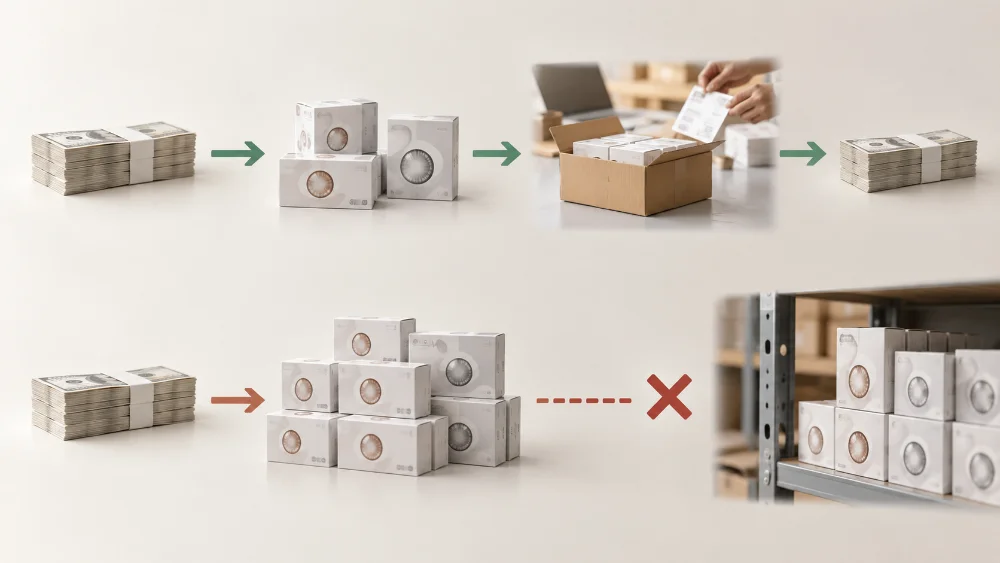
The cash she had used to buy those products had not disappeared. Some had returned through sales and could be used again. Some remained committed to inventory that was still waiting to sell.
For a growing colored contact lens business, that creates a more useful question than simply asking which products are slow:
Does the amount of cash committed to each product still match what demand has proved?
Inventory Is Where Yesterday’s Buying Decisions Still Live
Big Eye Brown did not become a problem on the day Alya noticed it was moving slowly.
The important decision had happened months earlier.
The style had been selling well enough to give her confidence, so she bought more deeply when she reordered. At the time, that decision made sense.
Demand later softened.
The cash used for those additional units was still there—just in a form Alya could not use for her next order. Until more of that stock sold, part of her buying capacity remained committed.
This becomes harder to see as an assortment grows.
A seller may have products bought for very different reasons. Some have a long history of steady demand. Some broaden the assortment. Some are recent tests. Others were purchased more deeply because of a strong period of sales that may or may not have continued.
Months later, they all appear simply as inventory.
But looking at what remains can tell you something about the purchasing decisions that created it.
A SKU that repeatedly sells through a reasonable stock position is giving you one kind of evidence. A SKU that still holds a large position long after the demand that justified it has weakened is giving you another.
That makes current inventory useful for looking backward as well as forward.
Before the next order, ask not only:
What do I still have?
but:
Why do I still have this much of it?
Slow Does Not Automatically Mean Too Much
Soft Gray created a different problem for Alya.
It sold more slowly than Natural Brown, but it continued to sell. It also gave customers a gray option that served a clear purpose alongside her natural brown products.
Removing it simply because it moved more slowly would have confused two different decisions.
Soft Gray did not necessarily need to disappear. It might simply need less inventory behind it.
A product can deserve a place in the assortment without deserving the same stock depth as a core seller.
That is why sales speed should not be read by itself.
A product selling ten pairs over a given period with only a modest amount left on hand is in a very different position from one selling at the same pace while enough stock remains for many more selling periods.
The sales speed may be similar. The amount of purchasing cash still committed is not.
The direction of demand matters too.
Slow but consistent demand can support a controlled inventory position. A product that has been weakening over several periods deserves more caution, especially when substantial stock is already on hand.
Then there is the role of the product itself.
A moderate-selling gray style may still add useful choice to the assortment. But if several nearly interchangeable gray styles are all moving slowly while carrying deep inventory, the problem may extend beyond one SKU. Too much cash may be spread across overlapping choices.
This is where inventory management meets assortment planning. Our guide to How to Build a Balanced Colored Contact Lens Collection That Actually Sells looks more closely at how different styles can play different roles within the same collection.
Keep the Assortment. Change the Depth.
Once Alya stopped treating product presence and inventory depth as the same decision, she no longer had to choose between fully stocking a SKU and removing it.
Natural Brown could carry deeper working stock because repeated demand gave that inventory something to do.
Soft Gray could remain available at a lighter depth.
Mist Gray could stay small while Alya learned whether early interest would develop into sustained demand.
And with plenty of Big Eye Brown already available, there was little reason to add more simply because she had replenished it heavily in the past.
This leads to a practical way to review inventory before another wholesale order.
Instead of ranking every SKU from “good” to “bad,” compare what demand has proved with how much inventory you are still funding.
| What You See | What to Look at Before Buying More |
|---|---|
| Strong, recurring demand with stock running down | Whether current depth is enough to support normal sales |
| Moderate but steady demand | Whether the product can stay available with a lighter position |
| Useful style with limited demand | Whether assortment presence requires as much stock as you currently hold |
| New product with promising early sales | Whether there is enough history to justify a larger commitment |
| Weakening demand with substantial stock remaining | Whether existing inventory should work down before more is added |
This comparison matters more than trying to make every SKU reach the same inventory level.
A seller can maintain broad customer choice while keeping very different amounts of stock behind different products.
That becomes increasingly important as the assortment expands. Small amounts of unnecessary depth across many SKUs can collectively absorb far more buying capacity than one obviously overstocked product.

The Real Cost Appears When Another Product Needs the Cash
For Alya, the Big Eye Brown position became much easier to understand when Natural Brown started running low.
Natural Brown was giving her current evidence that more stock had a job to do.
Big Eye Brown was still carrying inventory purchased against older evidence.
The problem was no longer simply that one style sold slowly. It was that a past inventory commitment was reducing Alya’s flexibility when another product needed attention.
This is the hidden cost of carrying more stock than a SKU currently justifies.
The money cannot simultaneously support a proven seller, test a new product or remain available for the next change in demand.
That does not mean purchasing should swing toward whichever SKU performed best last week. Promotions, marketplace exposure, seasonality and new-product launches can all produce short-term movement.
The useful comparison is broader:
Has demand provided enough evidence to justify the amount of inventory you are continuing to hold or add?
If not, the next order is an opportunity to change the depth rather than automatically recreate the previous inventory structure.
What Alya Changed in Her Next Wholesale Order
Natural Brown was the easy decision.
Stock was falling while sales remained consistent, so Alya gave it more room in the next order.
Soft Gray required more judgment. She still wanted the style in the assortment, but there was no reason to replenish it to the same depth as Natural Brown. She bought more conservatively instead.
Big Eye Brown required even less action. There was already enough stock on hand, so Alya simply stopped adding to it for that buying cycle and allowed existing inventory to continue selling.
Mist Gray stayed small. A few encouraging weeks had made it worth watching, but not yet worth scaling.
Early sales earn attention, not automatically deeper inventory.
Alya had not dramatically reduced her assortment, nor had she treated every slower product as a failure.
She had changed where the next order placed its inventory commitment.
That left more room behind products with established demand without forcing every other product out of the collection.
The Next Buying Cycle Can Change the Answer
The adjustment did not settle every product decision permanently.
That was not the point.
Natural Brown continued moving and now had enough stock to support that demand without the same immediate replenishment pressure.
Big Eye Brown continued selling too, but not quickly enough to give Alya a reason to rebuild its previous inventory position.
Mist Gray gained another cycle of sales history.
Soft Gray was the surprise.
Alya had reduced its inventory depth because the old position looked heavier than its sales justified. During the following cycle, however, it moved faster than she expected and began approaching a level where another order would soon be needed.
So Alya adjusted again.
She did not automatically return to the old stock level, but she gave Soft Gray slightly more room in the following order.
The earlier reduction had not been a mistake simply because she later increased it again. It had allowed her to make a smaller commitment, observe what customers actually did, and make the next decision using newer evidence.
This is why inventory depth should not become a permanent label attached to a product.
Demand changes.
If a lighter inventory position continues to support normal sales, the previous depth may have been unnecessary. If stock begins running down faster than expected, the SKU may deserve more room again. If demand keeps weakening while substantial stock remains, eventually the question may shift from how deeply to stock the product to whether it still deserves the same role in the assortment.
At that point, other purchasing decisions come into play.
How to Use Sales Data to Decide Which Colored Contact Lens Styles to Restock looks more closely at whether another order is justified.
For products that clearly do need continued replenishment, How to Set Reorder Points for Colored Contact Lenses Without Overstocking addresses a different question: when should the next reorder happen?
This article sits between those decisions.
It is not simply asking whether to reorder or when to reorder.
It asks how much of your buying capacity a product currently deserves.
Give Inventory Depth to the Products That Earn It
Alya’s assortment did not become dramatically smaller.
What changed was how much purchasing capacity each part of it was allowed to hold.
That gave her something an equally deep inventory position across every SKU could not: room to respond when customer demand changed.
Before your next wholesale order, the most useful question may therefore be more specific than:
Which products are moving slowly?
Ask instead:
Does the amount of cash committed to each product still match what demand has proved?
If the answer changes, inventory depth can change with it.
If you are planning your next wholesale order, explore the UYAAI Wholesale Catalog to compare styles and build an assortment with different inventory roles.