
A beauty retailer asks their colored contact lens distributor for six new styles.
The store already carries twelve. Natural brown lenses are selling steadily, but several gray and expressive designs have barely moved in three months. The owner believes a fresh collection will bring customers back to the display.
There is one problem: nearly half of the previous purchase is still in stock.
Ordering new designs would give the retailer something different to promote, but it would also commit more purchasing money before the existing assortment had been properly evaluated.
The distributor faces a familiar choice. Accept the new order, or help the retailer understand why some products are not selling before recommending replacements.
Neither option is automatically right. A store that never updates its assortment can lose opportunities, while one that constantly replaces slow sellers may accumulate inventory faster than customers can buy it.
The useful question is which products deserve another opportunity, which should stop receiving replenishment, and how much room the retailer can realistically make for something new.
These decisions are part of the broader support discussed in How Colored Contact Lens Distributors Can Help Retail Partners Sell More. They become particularly important when a retail partner’s first few orders have already revealed differences in customer demand.
Three Slow-Selling Styles Can Tell Three Different Stories
Imagine three colored contact lens styles that each sold three pairs during the same month.
The first is a soft gray lens. Customers regularly ask how the color looks on dark eyes, but many leave without purchasing.
The second is a highly expressive design. It has been displayed prominently, yet staff remember very few customer inquiries.
The third is a natural brown style that previously sold several pairs each week. Its recent sales have slowed as customers increasingly choose a similar brown design.
All three have the same monthly sales figure. Their problems are different.
The gray lens has signs of interest but uncertain conversion. The expressive style has little evidence of demand from the store’s regular customers. The natural brown may be losing sales to a nearby alternative rather than losing relevance altogether.
A retailer looking only at units sold might remove all three.
A distributor reviewing the store’s experience would ask different questions.
How many customers actually encountered each product? Were the lenses available throughout the period? Did shoppers ask about a particular visual effect? When they rejected one style, did they buy something similar?
These observations do not require sophisticated software. A store owner can often reconstruct useful patterns from transaction records, staff conversations, and a short period of deliberate observation.
However, the observation period must make sense for the business.
Three weeks without a sale in a small shop with limited customer traffic says less than three months of weak performance in a busy retail location. A style that was unavailable or incorrectly displayed for much of the period has not received a fair test.
The distributor should also distinguish between slow sales and excessive stock. A product selling steadily at two pairs per week may appear slow when the retailer originally purchased enough inventory for several months.
Before discussing replacements, the retailer needs to understand whether the problem is demand, presentation, or simply how much was purchased.
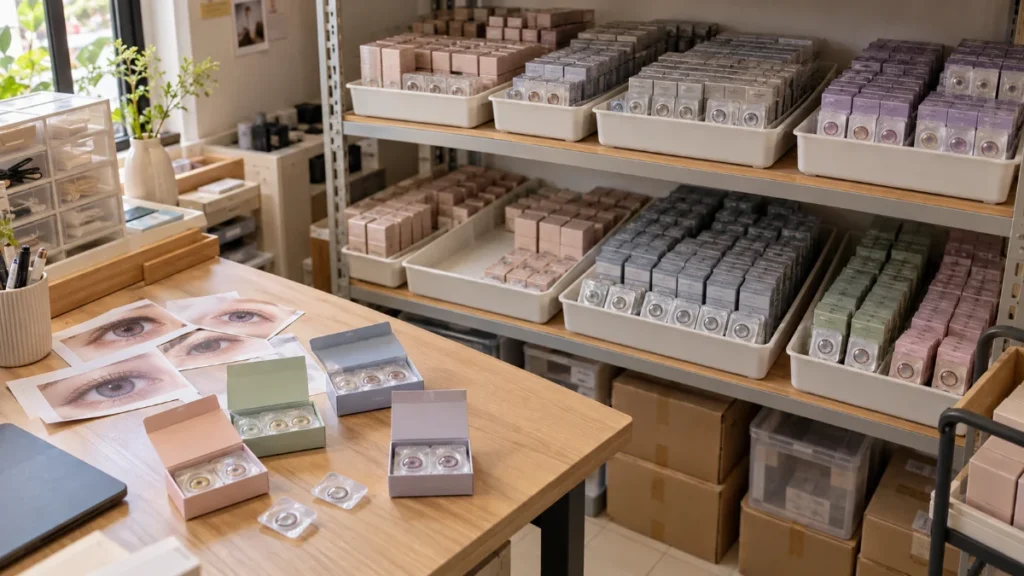
A Malaysian Retailer Wanted Six New Styles Before Selling the Old Ones
The following is an illustrative business scenario. All quantities, purchasing decisions, and outcomes are hypothetical and are not presented as an actual UYAAI customer experience.
A small beauty retailer in Malaysia had been selling colored contact lenses for approximately three months.
The shop carried cosmetics and beauty accessories alongside a modest colored lens display. Most customers purchased in person, while occasional social media posts helped introduce new products.
Its initial lens assortment included twelve styles: five natural browns, three grays, two hazels, and two more expressive designs.
For this example, assume the retailer purchased 240 pairs, allocating 20 pairs to each style.
At the end of the first three months, the store had sold 126 pairs. The remaining 114 pairs represented nearly half of its original purchase.
Sales were uneven.
Two natural-brown styles had sold 18 and 17 pairs respectively, leaving only a small quantity of each. Several other everyday styles had produced moderate sales. Some gray and expressive designs still had most of their original inventory.
The owner had already planned a small promotional launch for the following month. They wanted six new designs, updated product photographs, and a refreshed display before the campaign began.
But the purchasing budget was limited.
Buying another six styles in similar quantities would mean purchasing 120 additional pairs while 114 pairs from the original order remained unsold.
Even before accounting for packaging, display materials, or promotional costs, the retailer would be increasing its inventory commitment substantially.
The owner saw a different risk: if the store continued displaying the same collection, customers might lose interest.
The disagreement over the gray lenses
The retailer initially wanted to remove all three gray designs.
They had sold more slowly than the natural browns, and the owner believed local customers preferred warmer colors.
The distributor questioned whether the three products should be treated alike.
One soft gray design had sold only five pairs, but staff recalled repeated questions about how it would appear on naturally dark brown eyes.
Several customers had compared it with a softer brown-gray option before choosing the latter.
A second gray design had received very little attention. Staff could not recall meaningful customer inquiries, and its remaining stock was almost unchanged.
The third had performed moderately during the first month before slowing.
The owner considered all three unsuccessful. The distributor saw three different levels of evidence.
They also discovered that the store’s product photograph for the first gray lens did not communicate its appearance clearly. The image was technically associated with the correct SKU, but its lighting made the lens appear noticeably lighter than customers expected.
That did not prove the photograph was responsible for weak sales. It did provide a specific issue worth correcting before abandoning the style.
The distributor supplied more suitable product imagery and confirmed the corresponding product information. The retailer agreed to observe the soft gray design for another selling period rather than reorder it immediately.
The second gray design would receive no further replenishment unless new evidence of demand appeared.
The third remained available, but the retailer postponed a purchasing decision until the remaining inventory had moved further.
The cost of replacing products too early
The six proposed new styles created another problem.
The retailer was treating every new product as a replacement, although several existing styles still served identifiable customer preferences.
Two natural-brown designs had generated repeat purchases. Removing either would have disrupted an established buying pattern.
Another brown style was selling more slowly because customers increasingly preferred a similar design with a softer outer ring. Keeping both in equal quantities made little sense.
Meanwhile, the expressive lenses were attracting limited interest from the shop’s everyday beauty customers. Introducing more expressive designs simply because they were new would have repeated an unproven assumption.
The retailer and distributor reviewed the proposed launch again.
Instead of introducing six styles, the retailer chose two candidates that offered genuinely different appearances from the existing assortment. They postponed the other four.
The retailer also decided to use part of the available purchasing budget to maintain supply of the two natural-brown products with demonstrated repeat demand.
This changed the purpose of the next order. It would support products customers were already buying while leaving room for a small, controlled introduction.
What happened during the next review
For illustration, assume the retailer reviewed sales and customer feedback over the following six weeks.
The revised photograph helped staff explain the soft gray lens more accurately. Some customers who had previously hesitated made purchases, although the style remained a modest seller.
The second gray design continued receiving little attention, reinforcing the decision to pause replenishment.
The two established natural-brown products maintained repeat demand. The retailer could therefore justify prioritizing them in the next purchase.
One newly introduced candidate attracted encouraging interest. The other received only occasional inquiries, leaving its longer-term potential uncertain.
The retailer had not solved the entire inventory problem. Some original products remained on the shelf, and the new styles had not yet established reliable sales histories.
But the business had avoided committing to four additional untested designs, while directing more of its available budget toward products with existing demand.
The distributor also had better information for future recommendations: which natural looks the store’s customers preferred, which gray effects created interest, and which expressive designs did not fit the current audience.
The result was a more defensible purchasing decision, not a dramatic sales transformation.
When Is a Slow Seller Worth Testing Again?
A retailer should have a reason to continue testing a product beyond the hope that it might eventually sell.
Customer interest is one possible reason, but it needs to be interpreted carefully.
Suppose two styles each sell three pairs during a six-week observation period.
Customers ask about Style A twelve times. Several compare its appearance with a similar product, and some purchase that alternative instead.
Style B receives one recorded inquiry, despite being visible to the same type of shopper.
The inquiry counts are illustrative, not universal thresholds.
Style A offers a specific question to investigate: why are interested customers choosing something else?
The retailer can check whether the product photograph accurately represents the lens, whether staff understand its visual effect, and whether a nearby style better satisfies the same preference.
Style B presents a different decision. Without evidence of customer interest, ordering more units would be difficult to justify.
This is also where retailers need to separate an improvement in presentation from an improvement in actual demand.
A clearer photograph might help shoppers understand a product. It cannot guarantee they will want it.
The practical guidance in How to Display Colored Contact Lenses to Increase Store Sales can help when the issue involves how products are presented to customers.
A further test should have a defined observation period and a clear question. For example, after updating an inaccurate or unclear display image, does the retailer see more informed inquiries, more purchases, or continued preference for another style?
If the store cannot explain what new information the test is expected to produce, extending it may only delay the purchasing decision.
The retailer should also account for available stock. A product with substantial remaining inventory can often be observed without placing another order.
Testing demand and replenishing inventory are separate decisions.
Some Products Need to Leave the Assortment
Not every slow-selling lens deserves another campaign, a better photograph, or more time.
A style may have been displayed accurately, explained properly, and offered to relevant customers without generating meaningful demand.
Another may compete with a similar product that shoppers consistently prefer.
In those situations, continuing to purchase the weaker style uses money and shelf space without a convincing commercial reason.
However, a distributor should avoid treating a product’s poor performance at one retailer as evidence that it is unsuitable everywhere.
A dramatic gray lens may struggle in a neighborhood beauty shop focused on natural everyday looks. The same design could be relevant to a retailer serving customers who actively seek visible cosmetic effects.
The decision depends on the store’s audience and product role.
There is also a distinction between removing a style from future purchasing plans and disposing of its existing inventory.
Stopping replenishment does not make the remaining units disappear.
A retailer may continue offering commercially suitable stock where permitted, adjust its assortment as units sell, or consider other lawful inventory-handling options appropriate to the product and market.
Colored contact lenses are regulated products in many markets. Expired, damaged, improperly stored, or otherwise unsuitable lenses should never be treated as ordinary promotional merchandise.
For the distributor, the most useful support may be straightforward: provide accurate product information, confirm the applicable product and storage requirements, and avoid encouraging the retailer to purchase additional quantities of a style with weak demand.
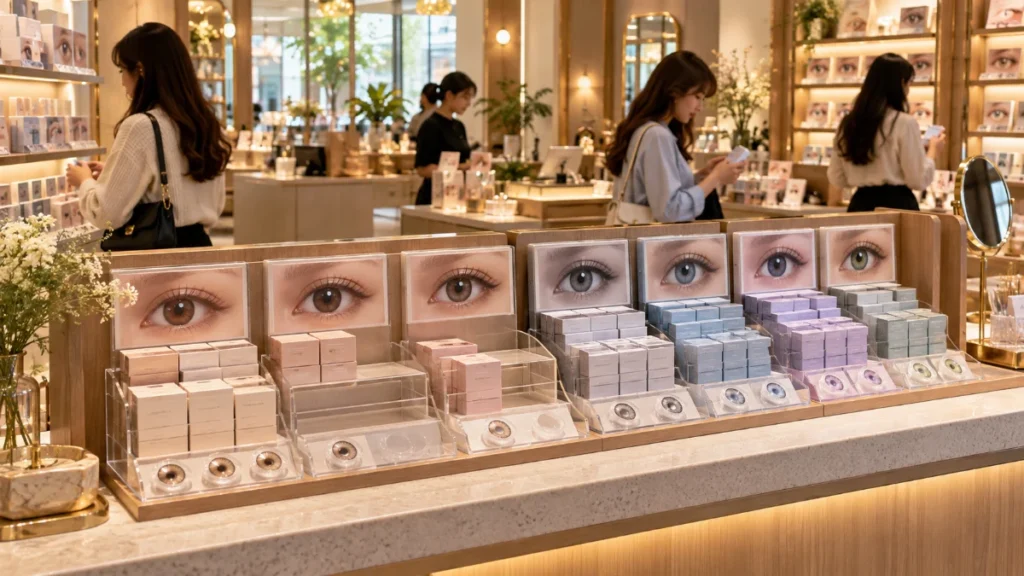
Plan the Next Wholesale Order Around What the Store Has Learned
Return to the Malaysian retailer.
The original proposal was straightforward: replace six existing styles with six new designs.
After reviewing the store’s sales, that proposal no longer reflected its actual needs.
The next purchase had three different purposes.
First, the retailer needed to protect availability of the two natural-brown styles that customers were repeatedly buying.
Second, the retailer wanted to introduce two visually distinct candidates without committing to a broad collection refresh.
Third, the retailer needed time to sell or reassess the remaining inventory from products that no longer justified automatic replenishment.
These requirements should influence the quantities purchased, not just the names of the selected SKUs.
Why the next order should not repeat the first
The initial order of 240 pairs had spread inventory evenly across twelve styles.
That made sense as a simple starting arrangement, but three months of sales had shown that demand was not evenly distributed.
Repeating 20 pairs per style would ignore that evidence.
In this illustrative scenario, suppose the retailer plans a 100-pair purchasing budget for its next order.
A possible allocation would be 35 pairs for each of the two proven natural-brown styles and 15 pairs for each of the two new candidates.
That is 70 pairs supporting established demand and 30 pairs testing new products.
This allocation is not a recommended industry formula. It is an example of how purchasing quantities can reflect different levels of demand evidence.
The retailer would still need to check whether 35 pairs per core style are appropriate for expected sales during the next replenishment period. If the existing inventory already provides sufficient coverage, purchasing those quantities immediately could create another overstock problem.
Likewise, 15 pairs may be too many for a small retail experiment if the store has limited traffic. The final quantities should reflect actual sales velocity, inventory on hand, and the retailer’s purchasing arrangements.
The lesson from the earlier order is that equal quantities are not automatically sensible when product demand is unequal.
How this affects the distributor’s own purchasing
A distributor serving multiple retail accounts has another consideration.
The Malaysian retailer’s needs may not justify a particular wholesale order on their own. But the distributor may also supply other stores that regularly purchase similar natural-brown products or want to test related designs.
Combining documented requirements across retail accounts can help the distributor plan its own purchasing more accurately.
UYAAI’s branded wholesale terms start at 100 pairs per order, with a minimum of 5 pairs per SKU.
These are wholesale purchasing conditions. They do not mean that every retail store must purchase 100 pairs individually, nor do they guarantee that a distributor can obtain every requested style in every quantity.
A distributor should confirm available products, stock, order terms, and relevant market requirements before committing to its retail customers.
Product photographs, accurate specifications, and information about available alternatives can also help retailers prepare for their next assortment change without unnecessarily expanding the number of styles they carry.
For more detailed replenishment planning, see How to Use Sales Data to Decide Which Colored Contact Lens Styles to Restock.
What Retailers and Distributors Need From Each Other
A retailer understands its customers in ways that a distant supplier cannot.
Store staff hear the questions shoppers ask. They see which products customers compare, which styles they return to purchase, and which designs receive little attention.
The distributor sees a different part of the business.
It may have access to a broader product range, understand available alternatives, and coordinate supply for several retail accounts.
These perspectives become useful when the information moves in both directions.
A retailer who simply requests new styles gives the distributor limited information.
A retailer who explains that natural-brown designs are selling consistently, that customers are asking for a softer gray, and that two expressive products remain largely untouched provides a much stronger basis for the next recommendation.
The distributor can respond with relevant product options, accurate visual materials, specifications, and realistic wholesale purchasing information.
This exchange does not need to become a complicated reporting process.
For a small retail account, a short conversation supported by sales records and a few specific customer observations may be enough to improve the next order.
The retailer remains responsible for its own sales and inventory decisions. The distributor contributes product knowledge and supply options that make those decisions better informed.
That is a more sustainable basis for repeat purchasing than introducing new designs whenever the previous collection begins to look familiar.
Better Decisions Before the Next Shipment
Slow-selling colored contact lenses will appear in almost every assortment that offers customers meaningful choice.
Some styles need better presentation. Others deserve limited additional observation. Some should simply stop receiving replenishment.
The difficult part is recognizing the difference before committing more purchasing money.
For retailers, that means examining what customers actually do rather than replacing products based only on disappointing sales totals.
For distributors, it means recommending products that fit the retail account’s demonstrated needs, while being realistic about remaining inventory and the next wholesale order.
A useful assortment is built through those decisions over time.
Explore Colored Contact Lenses for Your Retail Market
UYAAI supplies colored contact lenses for wholesale and distribution, with product options suitable for different retail preferences and market requirements.
If you are planning your next wholesale order, share your target market, current best-selling styles, preferred visual effects, and approximate purchasing requirements.
Our team can help you review available product options and relevant wholesale terms before you place an order.