
A beauty retailer asks a colored contact lens distributor for recommendations. The distributor sends a catalog featuring dozens of styles, several new arrivals, and a selection of popular colors.
A few days later, the retailer orders three familiar brown lenses.
The distributor might assume the store is being overly cautious. Perhaps it needs more choices, better product photographs, or a stronger promotional offer.
But the retailer may be facing a different problem.
Customers frequently ask how one brown lens differs from another. Employees are comfortable recommending familiar products but struggle to explain newer designs. Some styles attract attention without generating purchases.
Adding more products will not necessarily solve those difficulties.
For a colored contact lens distributor, helping retail partners sell more begins with understanding what happens after the wholesale order arrives.
Which products can store employees recommend confidently? Why do customers hesitate between similar styles? When a retailer says a lens is selling slowly, is the problem weak demand, unsuitable presentation, or the wrong product for that particular customer base?
The answers can change what a distributor should recommend next.
Why More Product Choices Do Not Always Help Retailers
A distributor may carry hundreds of products, but a retail store works with a much narrower set of customer needs.
Consider two businesses serving the same general market.
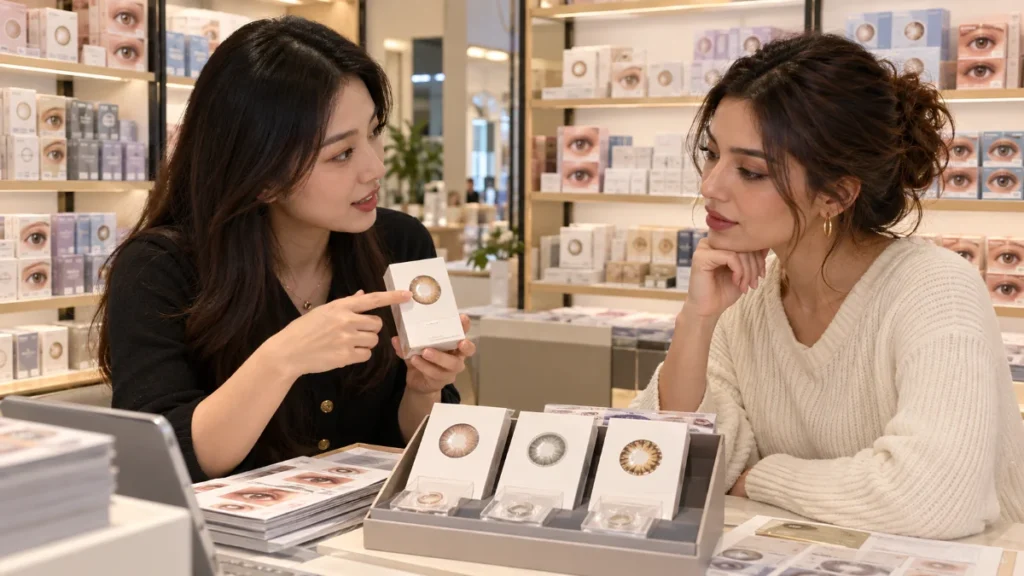
The first is a neighborhood beauty shop where customers often want natural-looking colored lenses for everyday use. Most sales involve face-to-face conversations, and employees can show customers several available options.
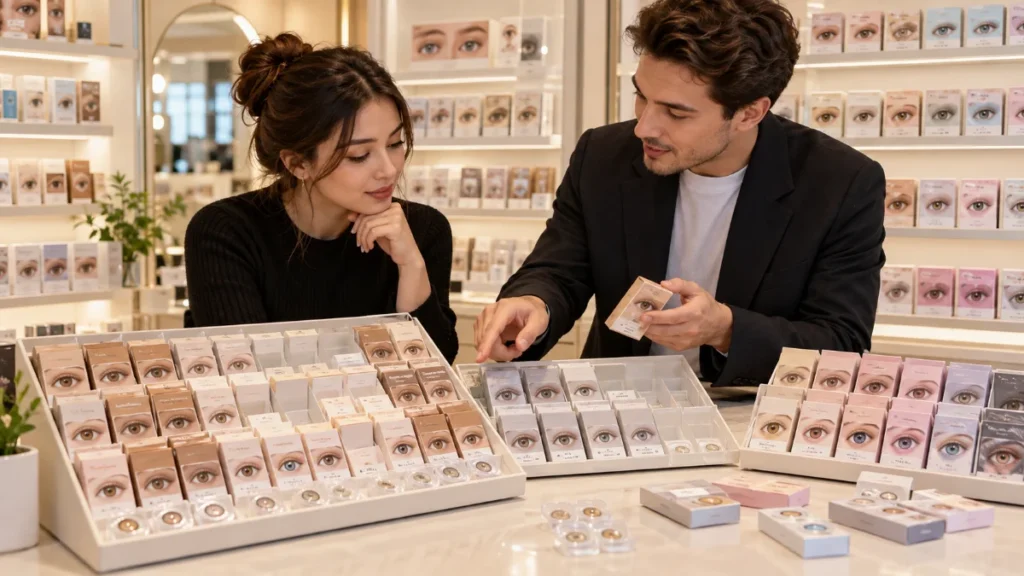
The second is an online seller using TikTok, Shopee, or other social-commerce channels. Customers encounter products through photographs, short videos, and mobile product listings before contacting the seller or placing an order.
Both businesses may carry natural brown, soft gray, and enlargement-effect lenses.
They do not necessarily need the same product recommendations or selling support.
Physical Stores Need Products Employees Can Explain
In a physical store, product variety becomes useful when employees understand the differences.
A retailer with six similar brown lenses may struggle to explain why a customer should choose one over another.
The problem becomes especially noticeable when products have different names but create closely related visual effects.
A distributor can help by identifying which styles offer genuinely different appearances and which are competing for the same customer preference.
For example, a store might benefit from having:
- A restrained natural-brown option for subtle everyday looks.
- A cooler gray or gray-brown style for customers seeking a different color direction.
- A more defined enlargement-effect style for customers who want a visibly stronger result.
This is an illustrative selection, not a universal assortment formula. The appropriate products depend on the retailer’s customers and the characteristics of the actual lenses.
The store can still carry a broader collection. These are simply clearer starting points for relevant sales conversations.
Online Retailers Face a Different Difficulty
For an online seller, a product can become difficult to sell before anyone asks a question.
Two styles that are distinguishable in person may look almost identical in small mobile thumbnails.
A photograph may emphasize a dramatic visual effect while the actual product produces a subtler appearance. A listing may also leave buyers uncertain about the differences between two designs.
In these situations, a distributor should help the retailer verify that product images, names, and descriptions accurately represent the corresponding SKUs.
The distributor may also recommend featuring fewer, more distinguishable styles within a particular promotion rather than presenting the entire wholesale range at once.
The goal is to make each product easier to recognize and compare.
For a broader discussion of how products should be organized within a collection, read How to Build a Balanced Colored Contact Lens Collection That Actually Sells.
When Similar Lens Styles Become Difficult to Sell
Imagine a customer looking at two natural-brown lenses.
Both appear attractive in the photographs. Both are described as suitable for a natural-looking effect. Their names are different, but the store employee cannot explain what meaningfully separates them.
The customer asks which one will look more subtle.
The employee shows another photograph.
The customer remains uncertain.
The distributor may never hear about this conversation. Instead, the retailer may later report that one of the two styles is selling poorly.
That report tells the distributor what happened, but not why.
Before recommending a replacement, the distributor should examine how those products are being presented.
Are their visual differences clear in the actual product images? Are the descriptions accurate? Do they serve distinct customer preferences, or are they effectively competing for the same position?
A useful comparison might look like this:
| Product Type | Distinguishing Feature | How a Retailer Might Explain It |
|---|---|---|
| Natural Brown | Restrained color enhancement | A subtle option for customers who prefer a natural appearance |
| Soft Gray | Cooler, more visible color effect | An alternative for customers interested in a noticeable but balanced change |
| Big Eye Brown | More defined enlargement effect | A choice for customers seeking stronger visual definition |
These are general illustrative style descriptions, not verified specifications of particular SKUs. The actual product’s appearance and documentation must support any customer-facing description.
The difference between a catalog description and a useful retail explanation is important.
A catalog identifies the product. A retail explanation helps the customer understand how it differs from the alternatives.
This does not mean encouraging employees to promise a particular appearance. Colored lenses can look different depending on a person’s natural eye color, lighting, and other individual characteristics.
Retail information must remain accurate, and sales guidance should never replace applicable product instructions, professional fitting requirements, or local regulatory obligations.

A distributor who identifies this type of selling difficulty has several possible responses.
If the products genuinely serve different preferences, the retailer may need clearer comparisons.
If the differences are too small to matter to the store’s customers, the retailer may be better served by emphasizing one style instead of both.
If customers repeatedly ask for an effect that neither product provides, a different design may be worth testing.
The correct action depends on what customers are actually doing—not simply on how many units remain in stock.
What Retailers Actually Tell Distributors About Demand
Wholesale order history provides useful information, but it leaves out part of the selling process.
A retailer may reorder a natural-brown style because customers consistently request it.
Another retailer may reorder the same style because employees are familiar with it and rarely recommend anything else.
The orders look similar. The opportunities are different.
Distributors do not need access to every retail transaction to begin understanding these differences. A short conversation with the retailer can reveal which products are working and where sales are becoming difficult.
Four Questions Worth Asking Before Recommending More Products
A practical retail partner review can begin with four questions.
| Question | What It Reveals |
|---|---|
| Which three styles have been easiest to sell recently? | Products customers already understand and accept |
| Which styles require the most explanation? | Possible confusion in product positioning or presentation |
| What do customers ask for but rarely find? | Potential gaps in the existing selection |
| Which products would you confidently reorder today? | Products the retailer considers worth purchasing again |
A distributor can discuss these questions in a short phone call, store visit, or routine customer follow-up.
The answers should lead to specific actions.
When two products are frequently confused, compare their actual visual characteristics and customer-facing materials before introducing another similar style.
When a product attracts attention but few purchases, ask what happens after the customer expresses interest. Does the customer choose a related design? Is the product photograph creating an expectation that the actual lens does not match? Is a commonly requested specification unavailable?
When a slower-selling style has a small group of repeat buyers, consider whether it deserves continued availability at a more limited purchasing depth rather than immediate removal.
When customers repeatedly request a style the retailer does not offer, look for a suitable product that could be tested without unnecessarily expanding the entire collection.
One customer’s comment is not enough to establish a market trend. Repeated observations across selling periods or retail partners provide stronger evidence.
The distributor’s role is to recognize which feedback deserves action and which needs further investigation.
This is particularly useful when working with several retailers. One store’s weak-selling product may perform well in another channel. Comparing the reasons behind those results can help the distributor avoid recommending the same assortment to every customer.
A Retail Partnership That Changed the Next Order
The following is an illustrative business scenario, not a documented customer case or a claim about actual UYAAI customer results.
Consider a small beauty retailer in Malaysia that purchases colored contact lenses through a regional distributor.
The store serves customers who generally prefer natural-looking lenses, but it also receives requests for gray styles and more noticeable enlargement effects.
Over several wholesale orders, the retailer has accumulated a fairly broad selection.
Four products become the focus of a discussion with the distributor.
Natural Brown A sells consistently. Employees know how to explain it, and customers frequently choose it without lengthy comparisons.
Natural Brown B attracts attention because its product photograph looks appealing. In the store, however, customers often compare it with Natural Brown A and eventually purchase the familiar style.
Soft Gray sells more slowly than either brown product, but a small group of customers regularly asks for it.
Big Eye Brown attracts strong interest from a particular type of customer, although demand is less consistent than for the natural styles.
The store owner wants to simplify the next wholesale order.
The initial proposal is straightforward: purchase more Natural Brown A, stop ordering Soft Gray, and add several new brown designs to replace the products that have been moving slowly.
From the owner’s perspective, this seems sensible. Brown lenses generate most of the store’s sales, and the retailer wants to concentrate on products with obvious demand.
The distributor agrees that Natural Brown A deserves continued attention.
The rest of the proposal is less convincing.
The Slowest Product Is Not Necessarily the Least Useful
During the discussion, the distributor asks why the owner wants to remove Soft Gray.
The owner explains that its total sales are lower than those of the natural-brown products.
But the store also reports that several customers specifically return to ask for the gray style.
Those repeat requests suggest that Soft Gray may be serving a narrower but identifiable customer group.
It is not necessarily competing with Natural Brown A.
Removing it entirely could leave the store without a suitable option for those customers.
The distributor suggests keeping Soft Gray available while reconsidering how much inventory the store commits to it.
That recommendation is different from treating every slower product as unsuccessful.
The store can maintain a useful product choice without giving that choice the same inventory priority as its strongest everyday seller.
A Popular Photograph Is Not Proof of Product Demand
Natural Brown B presents a different problem.
The product attracts interest, but customers frequently choose Natural Brown A after comparing them.
The retailer initially interprets this as a reason to seek another brown design.
The distributor asks the owner to review the two products more carefully.
Are customers struggling to see the difference? Does Natural Brown B offer a distinct appearance? Are employees able to explain why someone would choose it?
If the products look and perform too similarly in the store’s selling environment, adding another comparable brown SKU may make the decision even harder.
The distributor recommends pausing further assortment expansion in that particular product group until the store understands the source of the overlap.
Natural Brown B does not need to disappear immediately. Existing inventory can continue to be offered accurately, while the retailer observes whether customers have a clear reason to prefer it.
But the distributor does not recommend allocating more purchasing money to that product solely because its promotional photograph attracts attention.
A Smaller Customer Group Can Still Justify a Product
Big Eye Brown raises another question.
It appeals to customers seeking a more defined visual effect, but those customers represent only part of the store’s audience.
The owner is unsure whether to increase the quantity or remove the style.
Rather than treating its occasional popularity as proof of broad demand, the distributor suggests keeping it as a selective option and reviewing customer requests over another selling period.
If interest becomes more consistent, the store can reconsider its purchasing priority.
If it remains occasional, the style may still be useful without requiring deep inventory.
The Revised Purchasing Decision
The retailer and distributor eventually agree on a more focused direction.
Natural Brown A remains the main replenishment priority because it has demonstrated consistent demand.
Soft Gray stays in the collection, with purchasing depth reflecting its smaller but recurring customer base.
Natural Brown B receives no automatic increase until the store better understands why customers hesitate between the two brown products.
Big Eye Brown remains a limited option for customers seeking a more noticeable effect.
The store does not immediately introduce several additional brown styles.
Instead, employees pay closer attention to which comparisons customers make, which products they eventually select, and which questions remain unanswered.
At the next review, the retailer can bring specific observations rather than simply asking for more new designs.
The scenario does not demonstrate a guaranteed sales increase. Its value is in showing how different products can require different decisions even within the same retail store.
A distributor who had focused only on total sales might have removed Soft Gray, increased Natural Brown A, and expanded the brown selection.
By examining the store’s actual sales conversations, the distributor reaches a more selective recommendation.
The Next Wholesale Order Should Reflect What the Store Learned
A repeat wholesale order should be informed by the retailer’s selling experience, not just the quantities purchased previously.
For some products, the decision will be simple.
A familiar style is selling consistently, the retailer wants to maintain availability, and the distributor can confirm suitable stock and order conditions.
Other products deserve a closer conversation.
A retailer may want to remove a style that sells slowly but receives occasional repeat requests. Another may want to introduce five new colors because customers are asking for something different, even though the retailer cannot yet explain what those customers are looking for.
In those cases, the distributor should help separate three types of purchasing decisions.
Continue supplying proven products. Styles with dependable demand deserve appropriate attention, provided the retailer’s purchasing quantities remain consistent with its needs and available capital.
Keep useful niche products in proportion. A style does not have to outsell every other SKU to justify its place. It should, however, have an identifiable customer or commercial role.
Test genuinely different opportunities. A new product is more useful when it answers a specific customer request than when it merely increases the catalog count.
Retailers can use their sales history to decide how much stock to carry. For a more detailed approach to sales velocity, repeat purchasing, and replenishment quantities, see How to Use Sales Data to Decide Which Colored Contact Lens Styles to Restock.
Purchasing Flexibility Should Support Better Choices
A distributor’s recommended assortment is only useful if the retailer can purchase it under workable commercial conditions.
UYAAI’s standard branded-wholesale minimum order is 100 pairs, with a minimum of 5 pairs per SKU.
This provides a starting structure for discussing a selection that includes established sellers and smaller product trials.
For example, a retailer may wish to maintain its core natural styles while introducing a limited number of designs with more noticeable effects. Its specific allocation should reflect customer demand, available funds, and the applicable order conditions—not an arbitrary requirement to stock every style group.
Availability still matters.
UYAAI operates self-managed warehouses in Vietnam, Indonesia, Malaysia, and Thailand to support regional stock and restocking. Specific product availability, local regulatory requirements, and delivery arrangements must be confirmed for the relevant destination and order.
The distributor should discuss those conditions before a retailer builds a sales plan around a product it expects to replenish.
Better Retail Support Begins With Better Decisions
A distributor cannot control every factor affecting a retailer’s sales.
Local competition, consumer preferences, store presentation, customer service, pricing, and the retailer’s own marketing all influence purchasing decisions.
What a distributor can do is help retail partners interpret the evidence available to them.
When a customer struggles to distinguish two products, the next recommendation may be a clearer comparison rather than another SKU.
When a slower style has recurring buyers, the better decision may be to keep it available in a smaller quantity.
When a retailer requests several new designs, the distributor can ask which customer need those designs are expected to serve.
These conversations may not always produce the largest immediate wholesale order.
They can, however, help retailers make purchasing decisions that better match their actual businesses—and give distributors a more useful basis for long-term cooperation.
The next wholesale order becomes more meaningful when both sides understand what the previous products taught them.
Build a Retail-Ready Colored Contact Lens Selection With UYAAI
Whether you supply beauty shops, optical retailers, or ecommerce sellers, your wholesale assortment should reflect the customers those businesses serve.
UYAAI offers colored contact lens styles for different visual preferences and retail channels, including Natural, Big Eye, Soft Glam, Soft Hybrid, Bold Hybrid, and K-Beauty collections.
Explore the wholesale range and consider which products fit your existing sales channels, established bestsellers, and potential new customer needs.
When contacting our team, share your destination country, business type, preferred lens styles, and approximate purchasing requirements so we can discuss suitable wholesale options.