Selling colored contact lenses on Shopee, Lazada, or TikTok Shop can turn into a price comparison very quickly.
A shopper searches for brown lenses, opens several listings, and sees similar product images, replacement cycles, powers, and descriptions. If the differences are hard to understand, price becomes the easiest thing to compare.
That does not mean sellers should ignore price. Promotions, bundles, and tactical discounts can all make commercial sense.
The problem is dependence.
If every sale requires being cheaper than the next listing, margins shrink and the business has less room to invest in stronger inventory, better content, or faster restocking.
The alternative is not to make price irrelevant. It is to give shoppers more meaningful differences to compare.
For colored contact lens distributors and ecommerce sellers, that starts with the assortment itself.
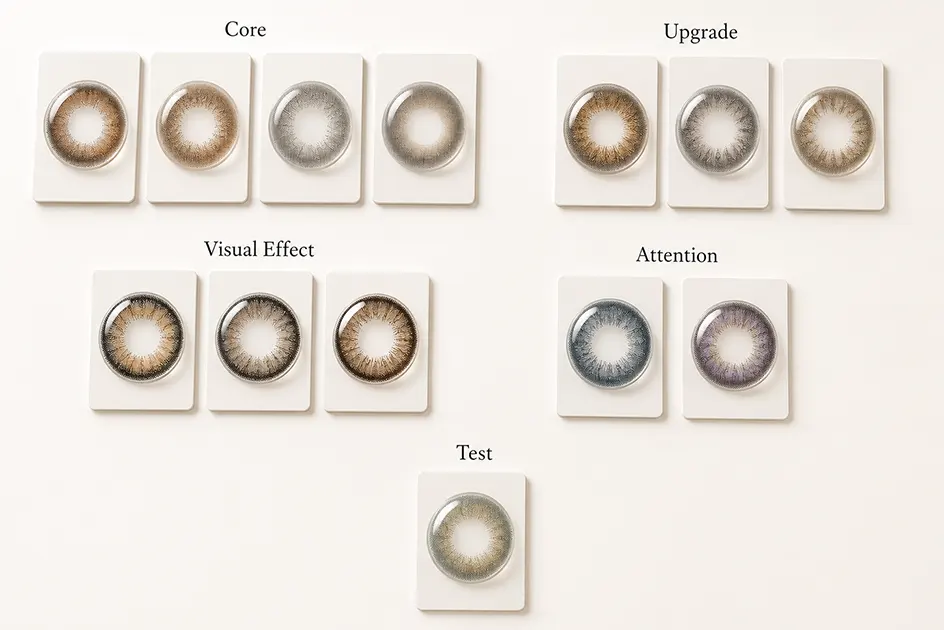
Give Different Products Different Jobs
A marketplace store can offer a large number of SKUs and still feel repetitive.
This happens when many products occupy essentially the same position: similar brown lenses, similar visual effects, similar images, and little explanation of why a shopper should choose one instead of another.
A smaller but more structured assortment may be easier to sell.
Product Role
Commercial Purpose
Core Natural Styles
Support steady everyday demand
Big-Eye Styles
Offer a clearly visible enlargement effect
Soft Glam / Hybrid
Give shoppers a step up from basic natural styles
Standout Colors
Create stronger visual interest and content opportunities
Test Styles
Validate demand before deeper stocking
Repeat Sellers
Keep proven products reliably available
The exact mix depends on the store.
What matters is that each product has a reason to be there.
If fifteen brown lenses all serve almost the same customer need, adding a sixteenth may increase catalog size without improving the offer.
This is especially visible on marketplace search pages. When several thumbnails from the same seller look almost interchangeable, the store begins competing with itself before it competes with anyone else.
A useful question is:
What role does this SKU play that another SKU does not?
That role might come from visual effect, customer use case, content potential, proven repeat demand, or simply a controlled test of a new direction.
Internally, sellers need product codes, inventory records, and precise SKU names.
Shoppers think differently.
They are more likely to ask:
Does this look natural?
Will it make the eyes appear larger?
Is the effect soft or obvious?
Which one works better with everyday makeup?
Which design will show more clearly in photos or video?
A store may have a perfectly organized backend while presenting a confusing storefront.
Instead of treating the entire assortment as one flat grid, products can be grouped around understandable visual roles such as:
Natural Everyday
Bigger-Eye Effect
Soft Glam
Stronger Color
Trend / Content Styles
This is not about inventing dramatic marketing claims. It is about reducing interpretation.
On Shopee or Lazada, shoppers may move through many similar listings within minutes. If several brown-lens thumbnails look almost identical, the seller has very little time to make the distinction clear.
Two stores can carry similar products. The one that makes those differences easier to understand gives shoppers more reasons to choose than the one that simply presents product names and prices.
Visual Content Should Remove Uncertainty
Colored contact lenses depend heavily on visual communication, but more images are not automatically better.
A useful image should answer a question.
For example:
What is the main wearing effect?
How does the lens look around the eye at closer range?
How is this style different from another lens in the same series?
What product information does the shopper need before choosing?
What will the actual product and packaging look like?
Five images repeating essentially the same model shot do not necessarily answer five different questions.
A single comparison image may do more.
The same principle applies to short-form video.
On TikTok Shop, a visually distinctive lens may gain attention because a video demonstrates its effect clearly. Once shoppers arrive at the listing, however, the page still has to help them understand what they are buying.
That includes clear style identification, useful wearing-effect images, easy power selection, consistent naming, and enough stock to support the traffic being generated.
Every important visual should remove one buying uncertainty.
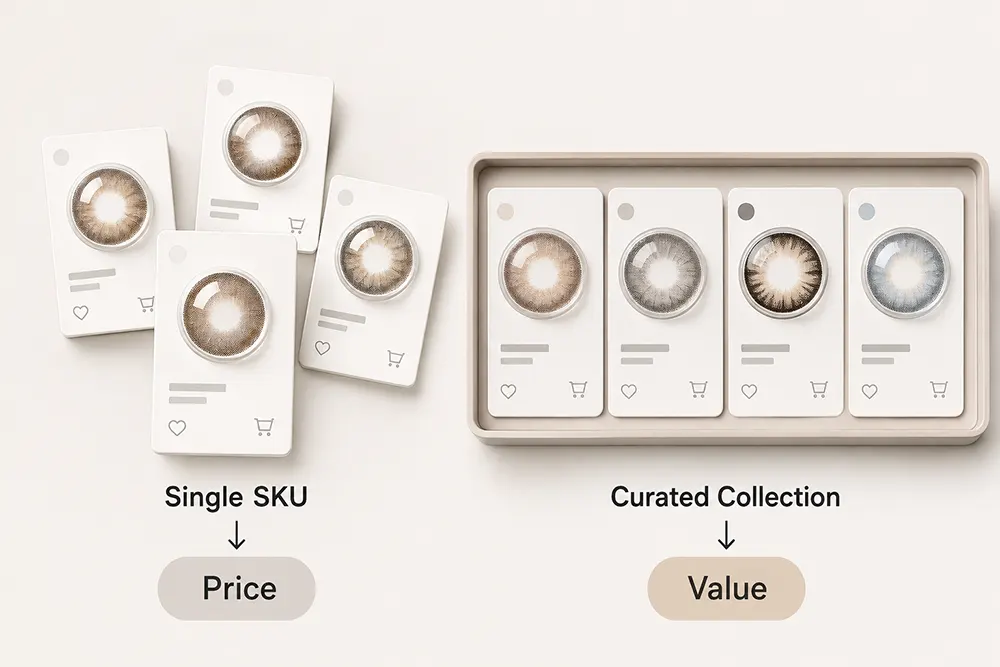
Direct SKU-to-SKU competition naturally pushes shoppers toward unit price.
Bundles and curated collections can change that comparison.
Instead of asking:
Which single brown lens is cheaper?
the shopper may begin asking:
Which group gives me the combination I want?
A seller could create an Everyday Collection built around several wearable natural styles.
A Discovery Collection could combine different visual directions for shoppers who are still exploring.
A Color Family Collection might bring together related brown or gray styles.
A Content Collection could group more visible designs that create noticeably different looks for photos or short-form video.
The value does not have to come from a large discount.
It may come from easier selection, a clearer theme, greater variety, or a more convenient way to explore the range.
This changes the comparison from:
Single SKU → Price
to:
Curated Collection → Value
Competitors may carry similar lenses.
They do not have to structure the offer in the same way.
A Viral SKU Is Only Useful If You Can Keep Selling It
This is where ecommerce strategy becomes inventory strategy.
Suppose a TikTok video performs unusually well.
One particular lens attracts attention. Customers click through. Orders rise.
The obvious response is to push the product harder.
But if the popular color or power sells out shortly afterward, the seller may lose more than a few immediate orders.
The stockout can interrupt:
creator links;
paid traffic;
organic product-page traffic;
recommendations;
repeat purchases;
related-product sales.
A product that gains visibility but repeatedly becomes unavailable is difficult to build into a dependable ecommerce asset.
That does not mean every SKU should receive deeper stock.
Inventory depth should follow evidence.
A product with stable repeat demand may deserve more stock. A new style may still be testing. A visually interesting SKU with irregular sales may stay lean. A product that consistently fails to move should not keep absorbing working capital simply because it remains in the catalog.
The next order should therefore rely less on what looks exciting and more on what the selling data shows.
Replenishment conditions also change the calculation.
If inventory can be replaced relatively quickly, a seller may need less safety stock than when every reorder depends on a long or uncertain replenishment cycle.
Marketplace sellers spend a great deal of effort getting the first conversion.
A successful product should also be easy to buy again.
A customer may like a particular brown lens and return months later.
If the product name has changed, the listing has disappeared, the packaging image looks completely different, or the style has been reorganized into an unfamiliar category, the customer has to rediscover something they already bought.
That is avoidable friction.
Repeat purchasing becomes easier when sellers maintain:
recognizable naming;
consistent style categories;
stable product information;
clear power selection;
reliable availability.
This does not mean keeping the assortment frozen.
New designs still matter, especially on visually driven channels.
But novelty and continuity play different roles.
New products help test demand and create attention.
Established products give customers something familiar to return to.
A mature assortment needs both.
Sometimes “Price Competition” Is Really a Positioning Problem
Marketplace price pressure is real.
But not every price problem starts with price.
Symptom
Possible Commercial Problem
Customers mainly ask about price
Product differences may be unclear
Listings receive traffic but weak conversion
Visuals or product information may leave questions unanswered
One lens sells while several similar SKUs remain slow
Too many products may be competing for the same role
A successful SKU repeatedly sells out
Inventory depth may be too shallow
Buyers rarely return to the same products
The repeat-purchase path may be weak
Sales rely heavily on continuous discounts
The offer may lack another clear reason to choose
These are starting points for diagnosis, not automatic conclusions.
Weak conversion can have several causes. A promotion can also be perfectly rational.
Discounting can help launch a range, clear selected stock, support a marketplace event, or encourage trial.
The risk is when discounting becomes the entire product strategy.
If a SKU only moves whenever its price drops, it is worth checking whether the deeper problem is weak differentiation, unclear presentation, too many similar products, poor availability, or simply weak demand.
Discounting can be a tactic. It should not become the entire positioning.
Give Customers More Than One Reason to Choose
Shopee, Lazada, and TikTok Shop will remain competitive.
Other sellers can discount, introduce similar colors, copy popular visual directions, and compete for the same traffic.
The objective is not to eliminate that competition.
It is to make sure the customer has more than one variable to compare.
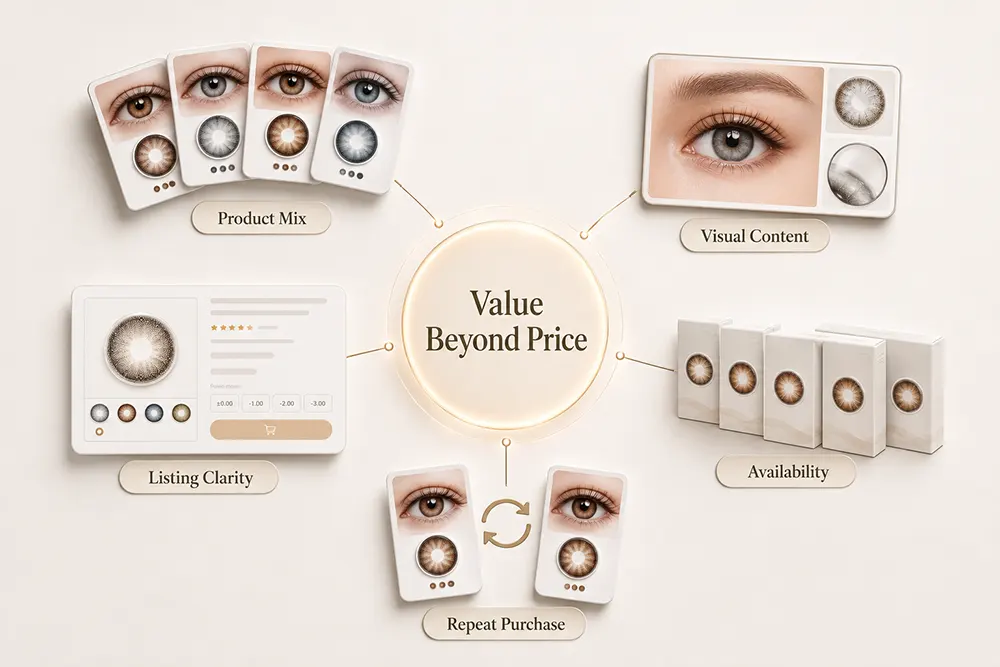
A stronger colored contact lens ecommerce offer combines:
the right assortment
clear differences between products
visual content that answers buying questions
reliable stock
an easy path to buy the product again
Price remains part of the decision.
It simply does not have to carry the entire decision.
If your current assortment is heavily concentrated in similar styles, the next step is not necessarily to add more SKUs. It may be more useful to identify which commercial roles are still missing—and which existing products already deserve stronger stock support.
Build a Product Mix That Gives Customers More to Compare Than Price
Use the UYAAI Wholesale Catalog to compare natural, big-eye, soft-glam, hybrid, and more distinctive colored contact lens styles according to the roles your store still needs to fill.
View Wholesale Catalog
Already selling colored contact lenses and planning your next assortment or restock? Submit a wholesale inquiry with your market, sales channel, and current product mix so the discussion can focus on the gaps and stock structure relevant to your business.
Submit Wholesale Inquiry
Wholesale Catalog
View UYAAI colored contact lens catalog
Browse natural lenses, cosplay lenses, monthly lenses, half-year lenses, and styles built for distributor channels.