
Selling more colored contact lenses does not automatically mean your business is ready to become a distributor.
A reseller can have a strong month because one style goes viral, a marketplace campaign performs well, or a promotion creates a temporary spike. That sales growth matters, but it does not prove that the business can support deeper inventory, predictable replenishment, or downstream buyers.
Consider two sellers.
The first moves a large volume after one TikTok video performs unexpectedly well. Most of the demand concentrates on two products, and the seller has little evidence that the same demand will continue.
The second grows more steadily. Several products sell every month, the business already knows which SKUs need regular replenishment, and a few beauty shops or smaller resellers have started placing repeat orders.
The second business may be closer to distributor readiness even if its latest purchase was smaller.
That is because:
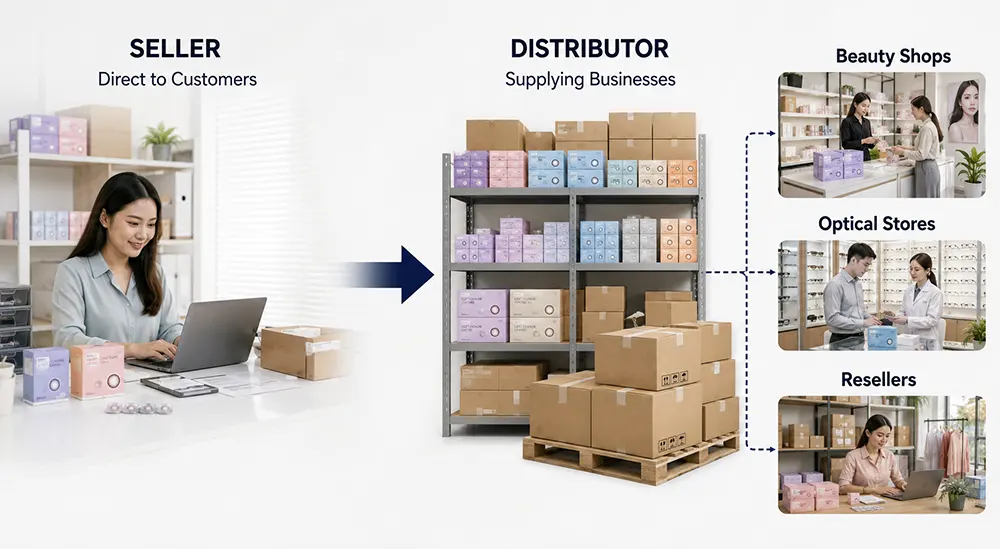
A distributor is not simply a reseller who orders more. A distributor is a business that can repeatedly turn inventory into reliable downstream supply.
The useful question is therefore not:
How big was my last order?
It is:
How repeatable has my business become?
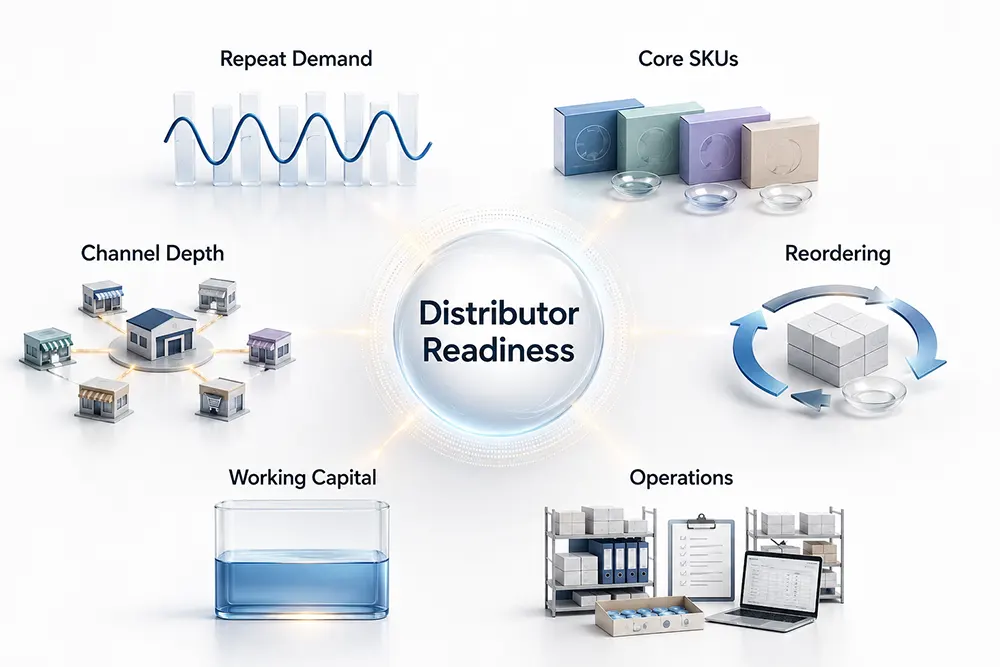
This guide uses six practical readiness areas to answer that question. At the end, you can score your business and identify what should improve before you pursue deeper distributor cooperation.
1. Can You Prove That Demand Is Repeatable?
One strong sales period is useful. It is not enough to justify substantially deeper inventory.
Start by reviewing several recent sales cycles and separating demand into three groups.
Repeat demand comes from products that continue selling after their initial launch, promotion, or content push. They may receive repeated customer requests, appear in multiple reorders, or sell across more than one channel.
Event demand comes from a temporary driver: a viral video, discount campaign, seasonal event, or marketplace promotion.
Unproven demand belongs to products that simply do not have enough history yet.
A simple review might look like this:
| SKU | Sales Pattern | Repeat Orders | Classification |
|---|---|---|---|
| Natural Brown A | Stable across several periods | Yes | Repeat Demand |
| Gray Big-Eye B | Strong after one campaign | No | Event Demand |
| Soft Glam C | Recently launched | Not enough data | Unproven |
The important question is:
If I reorder this SKU today, what evidence suggests that I will need it again?
If you cannot answer that for most of the products driving your sales, more market testing is usually more valuable than simply increasing order size.
This is where your existing sales data becomes useful. Sales velocity, repeat demand, stock coverage, and channel performance can help separate genuine winners from temporary spikes.
2. Do You Know Which SKUs Deserve Your Working Capital?
Knowing which products belong in your collection is different from knowing which products deserve deeper stock.
After several sales cycles, active SKUs should begin to fall into commercial roles.
| SKU Role | Inventory Approach |
|---|---|
| Core Seller | Protect availability |
| Reliable Secondary | Maintain normal coverage |
| Attention / Traffic SKU | Stock according to actual demand |
| Test SKU | Keep inventory lean |
| Weak SKU | Avoid deepening stock automatically |
A natural brown lens that sells consistently through several channels may deserve much more inventory than a highly visual style that mainly performs when promoted.
Both products can remain useful.
They simply should not receive the same amount of capital.
This matters more as the business grows. If 30 active SKUs all receive roughly equal stock depth, money is being distributed equally between proven sellers and uncertain products.
The result can be frustrating: your strongest products sell out while capital remains trapped in slow inventory.
Distributor-level stock planning therefore requires a harder question:
Which products must stay available when capital is limited?
If you still reorder most products in similar quantities simply because they appear in the catalog, the business may have a broad product range but not yet a mature inventory strategy.
3. Has Reordering Become Predictable?
Small sellers can often replenish reactively:
Stock is almost gone → contact supplier → reorder.
That becomes risky when sales volume and customer count increase.
A more reliable system only needs three basic inputs:
- current stock;
- recent sales rate;
- replenishment time.
Suppose a core SKU has 40 pairs remaining and has recently sold about 10 pairs per week.
That gives roughly four weeks of stock coverage.
If replacement inventory normally takes three weeks to become available, waiting another two weeks before placing the order creates an obvious stockout risk.
The calculation does not need to be sophisticated.
The behavior does.
A practical weekly review can be:
Check current stock → compare recent sales → estimate coverage → compare with replenishment time → reorder or monitor.
The key shift is from asking:
What is almost sold out?
to:
What is likely to become unavailable before replacement stock arrives?
Replenishment speed also affects how much inventory you need to hold. Access to regional stock or faster local replenishment may allow a business to operate with less safety stock than one depending on a longer supply route.
For multi-market sellers, this becomes even more important because the same SKU may deserve deeper inventory in one market and only light coverage in another.
4. Are You Building a Channel, or Just Selling More Yourself?
This is one of the strongest indicators of whether a reseller is beginning to operate like a distributor.
A strong reseller primarily sells products.
A distributor increasingly supplies other sellers.
Those are different roles.
A company can generate substantial sales through its own TikTok Shop, Shopee store, beauty shop, or ecommerce site and still remain primarily a retail business.
That may be exactly the right model.
Distributor readiness begins to appear when downstream demand starts becoming part of the business.
Examples include:
- smaller resellers asking to buy from you;
- beauty shops requesting repeat supply;
- optical retailers ordering several SKUs regularly;
- different customer groups requiring separate stock allocation;
- B2B customers checking availability before planning their next order.
The distinction becomes clearer here:
| Strong Reseller | Emerging Distributor |
|---|---|
| Primarily sells to end customers | Supplies repeat downstream buyers |
| Manages stock for its own channel | Allocates stock across customers or channels |
| Optimizes its own sell-through | Also supports downstream sell-through |
| Reorders for its own demand | Plans around broader repeat demand |
This matters because a downstream buyer relies on your availability differently from a retail consumer.
If one product goes out of stock in your own ecommerce store, you may promote another style.
A beauty shop that has already built customer demand around that SKU may not have the same flexibility.
Your stock problem becomes its stock problem.
That is why:
Three repeat downstream buyers can tell you more about distributor readiness than a large number of one-time consumer orders.
Distribution is not just higher sales volume. It is increased supply responsibility.
5. Can Your Working Capital Support Growth and Replenishment at the Same Time?
A larger purchase can improve commercial terms.
It can also weaken the business if too much cash becomes trapped in inventory.
Imagine a seller who normally buys 300 pairs and receives an attractive opportunity to purchase 1,000.
The larger order may look efficient.
But two months later, three proven core SKUs need urgent replenishment.
Can the business fund those reorders immediately?
Or does it have to wait for slower inventory from the larger purchase to sell first?
That is the more important test.
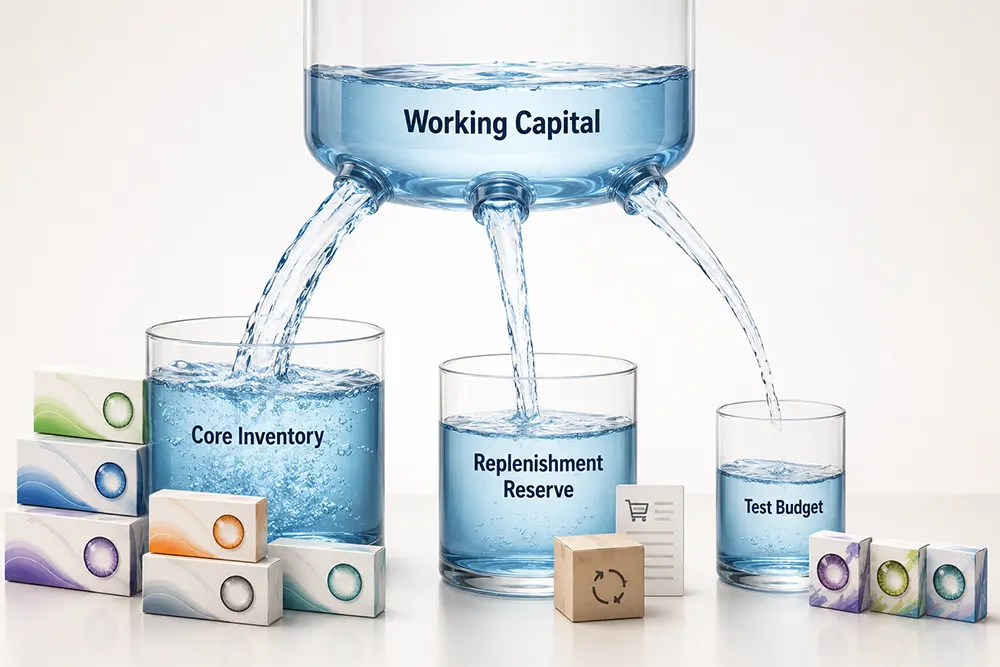
A useful way to think about inventory capital is to divide it into three roles:
Core Inventory
Capital committed to products with proven recurring demand.
Replenishment Reserve
Capital kept available for upcoming reorders.
Test and Expansion Budget
Capital used for new SKUs, channels, cities, or markets where demand is still being proven.
A practical stress test is:
If three of your strongest SKUs unexpectedly need replenishment next month, can you fund those orders without waiting for weak inventory to sell?
If the answer is no, increasing purchase size may make the business less flexible rather than more capable.
Distributor readiness requires enough working capital to hold inventory and continue replenishing the products that actually drive the business.
6. Can Your Operation Stay Accurate as Volume Increases?
You do not need enterprise software to become a distributor.
You do need reliable records.
At minimum, four areas should be under control.
Inventory visibility
You should know what is available, what is incoming, and which core SKUs are approaching reorder points.
Order records
Quotations, confirmed quantities, incoming orders, and customer commitments should remain consistent.
Product and document control
Specifications and available documentation should be organized by product rather than scattered across chats and files.
Customer and reorder tracking
You should know which downstream buyers reorder, what they normally buy, and when they are likely to need supply again.
A small distributor can manage these functions with relatively simple tools.
The standard is not complexity.
It is repeatability.
If doubling sales would also double stock errors, missed messages, or incorrect replenishment decisions, the operating system should improve before the commercial relationship expands.
Distribution adds responsibility before it adds scale.
Product and compliance documentation should also be confirmed according to the specific product and destination market. A certification shown for one product range or country should not automatically be assumed to apply to every SKU or market.
Distributor Readiness Scorecard
The six areas above can be turned into a simple self-assessment.
This is not an industry certification or regulatory qualification. It is a planning tool for deciding whether your business has developed enough structure to begin a serious distributor conversation.
Score each area:
0 — Not established
1 — Partly established
2 — Consistently established
| Readiness Area | 0 | 1 | 2 |
|---|---|---|---|
| Repeat Demand | Mostly unpredictable | Some repeat patterns | Clear recurring demand |
| Core SKU Clarity | Still guessing | Several likely winners | Core range clearly identified |
| Reordering | Mostly reactive | Partly planned | Predictable review and reorder process |
| Channel Depth | Mainly own retail | Some B2B buyers | Repeat downstream buyers |
| Working Capital | Expansion strains cash | Limited reserve | Can support stock and replenishment |
| Operations | Mostly reactive | Basic systems | Repeatable control |
0–4: Build the Foundation First
The business is probably still proving demand or relying heavily on isolated sales events.
Priorities should be:
- identify recurring demand;
- narrow the core range;
- improve inventory visibility;
- establish regular reorder reviews.
The goal is not yet “become a distributor.”
The goal is to make the current business more repeatable.
5–8: Transition Stage
Several distributor characteristics are beginning to appear.
You may already have repeat products, early B2B customers, and better inventory discipline.
Do not try to solve every remaining weakness by ordering more.
Find the weakest gate.
A business with strong demand but weak cash reserves has a different problem from one with excellent inventory control but no downstream buyers.
Fix that bottleneck first.
9–12: A Distributor Discussion May Make Sense
This score does not automatically qualify a business for distributor status.
It does suggest that several necessary commercial characteristics are already present:
- recurring demand;
- identifiable core SKUs;
- planned replenishment;
- downstream channel depth;
- sufficient inventory capital;
- operational control.
At this point, the useful supplier conversation changes.
Instead of asking only:
What is your wholesale price?
you can discuss:
- which market you serve;
- which channels you supply;
- which SKUs already perform;
- typical order volume;
- replenishment frequency;
- expected inventory needs;
- whether distributor cooperation fits the current stage of the business.
What to Fix Before You Apply
A lower score is not a failure.
It tells you what to improve.
If repeat demand is weak, continue testing and collect more sales history.
If core SKU clarity is weak, reduce product noise and identify the products actually carrying the business.
If reordering is reactive, introduce a fixed weekly inventory review.
If channel depth is limited, strengthen the current retail business and prove that additional B2B demand exists.
If working capital is tight, reduce inventory complexity before increasing purchase size.
If operations are inconsistent, standardize inventory, order, product, and customer records before adding more volume.
UYAAI branded wholesale orders can begin from 100 pairs, with a 5-pair minimum per SKU. That structure allows sellers to test products and build sales evidence without treating every new SKU as a major inventory commitment.
As demand becomes more repeatable, core products become clearer, replenishment becomes more predictable, and downstream customers begin relying on your supply, a deeper distributor relationship becomes more relevant.
The Real Transition Is from Selling Products to Supplying a Market
A distributor is not simply a reseller who places larger orders.
The real transition happens when a business becomes capable of repeatedly turning inventory into reliable downstream supply.
You should know what repeatedly sells.
You should know which SKUs deserve deeper stock.
You should know when those products need replenishment.
You should have enough capital to protect proven inventory without sacrificing the next reorder.
And increasingly, other businesses should be able to depend on your supply.
That is when distributor cooperation becomes commercially meaningful.
If your business already has recurring sales, identifiable core SKUs, planned replenishment, and growing downstream demand, submit a wholesale inquiry with your country, current sales channels, typical order volume, and the products you are already selling.
That information gives the UYAAI team enough context to determine whether standard branded wholesale or a deeper distributor relationship better fits your current stage.