
Getting a first order proves that a customer was willing to try a product. It does not tell you whether they will come back for it.
Consider a colored contact lens seller carrying three styles: Natural Brown, Soft Gray, and Big Eye Brown.
During the first month, Big Eye Brown sells the most. Natural Brown performs reasonably well but is not the bestseller. Soft Gray sits somewhere in between.
If the seller reviews only that first month, the conclusion seems straightforward: Big Eye Brown is the strongest product.
Two months later, the picture is less obvious.
Natural Brown keeps appearing in orders from customers who have bought before. Soft Gray itself has only moderate same-product reorders, but several customers who first bought it return for another gray or similarly subtle style. Big Eye Brown has another strong month, although much of that increase happens during a marketplace promotion.
Now the seller has a more useful question than simply asking which product sold the most:
What happened after the first purchase?
For colored contact lens retailers and ecommerce sellers, customer retention is partly a marketing problem. But it is also a product and assortment problem. Customers need to recognize what they liked, find it again, and have a clear path to either reorder it or move to another suitable product.
That means repeat purchase often starts before the second order.
Why Some First Orders Never Become Repeat Demand
A first purchase can happen for many reasons.
A customer may discover a style in a TikTok video. They may see a model image that catches their attention. A store employee may recommend a particular color. A marketplace promotion may make an unfamiliar product inexpensive enough to try.
All of those can create a sale.
What happens afterward is less predictable.
The customer who bought Natural Brown may decide that it works well as an everyday option and look for exactly the same product again.
Someone who tried Soft Gray may like the general effect but decide that the next pair should be slightly darker or more natural.
A customer who bought Big Eye Brown during a promotion may enjoy it without developing any particular preference for that SKU.
That is why similar first-order sales can eventually produce very different commercial value.
For a seller, the first order confirms that a product can attract demand. Several months of customer behavior begin to show what kind of demand it creates.
Make the Second Purchase Easier Than the First
A new colored contact lens customer often has to make several decisions before buying.
They may compare brown with gray, natural with more visible effects, different lens patterns, model images, and several products that initially look quite similar.
The first purchase gives the seller something valuable that did not exist before: a successful reference point.
Imagine a customer who bought Natural Brown and liked it.
Several weeks later, they return to the store. The assortment now includes Natural Brown, Soft Brown, Mocha Brown, Cocoa Brown, Natural Choco, and several new releases.
The seller knows which one worked before.
The customer may not.
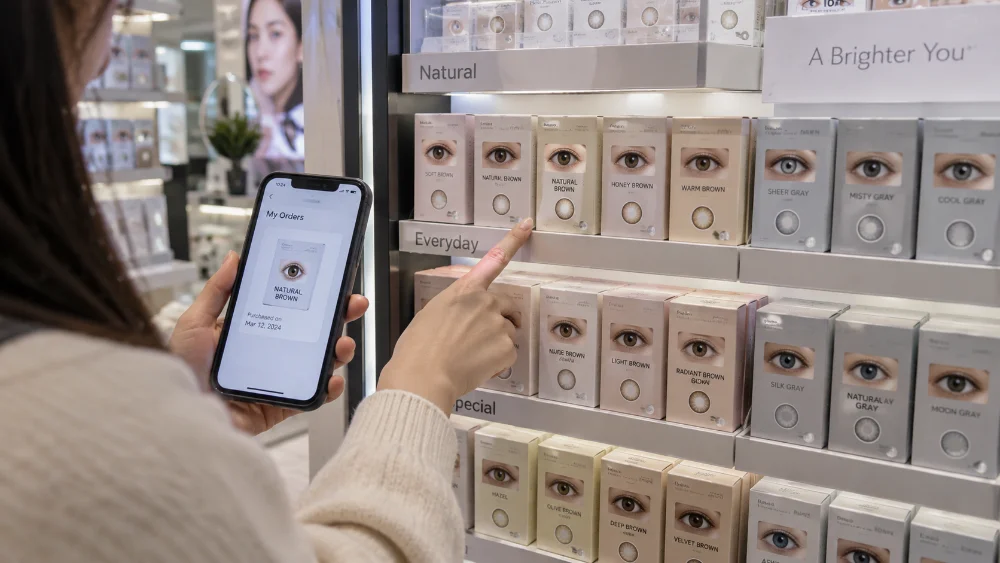
They might remember only “the natural brown one I bought last time.”
Product recognition matters after the sale
SKU codes are useful for inventory management. Customers are more likely to recognize a combination of product name, packaging, product image, lens appearance, or a model image they saw when making the first purchase.
This makes consistent product identity commercially useful.
Updating merchandising or improving a product page is normal. But frequently changing the way a familiar product is named, presented, or organized can make an otherwise simple reorder harder.
The problem becomes particularly noticeable when many products occupy nearby visual territory. Six brown styles may make sense as an assortment, but they also create six opportunities for a returning customer to wonder which brown they bought before.
Clear product pages therefore do more than help new customers make a choice. They also leave recognizable cues that can make the product easier to find later.
This is one reason product-page clarity matters beyond initial conversion. See How to Optimize a Colored Contact Lens Product Page for Easier Customer Choice for the first-purchase side of this problem.
Purchase history can shorten the process further. Marketplace order records, ecommerce accounts, or previous customer conversations may already contain the answer to “Which one did I buy?”
But finding the old SKU is only one possible outcome.
A customer may return because they liked Natural Brown but now want something slightly more noticeable. In that situation, the previous purchase is still useful—not as the product they must buy again, but as a reference point.
Instead of asking the customer to compare the entire catalog again, the seller can help them continue from a choice that already worked.
Natural Brown might lead to a lighter brown. A subtle gray might lead to another gray with a more visible pattern. An everyday style may give a customer enough confidence to experiment with something more distinctive.
This changes how repeat demand should be understood.
If a customer buys SKU A first and SKU B next, SKU A has not necessarily failed to create repeat business.
The more interesting question is:
Where do customers go after their first successful product?
Repeat Purchase Does Not Look the Same for Every Product
Return to Natural Brown, Soft Gray, and Big Eye Brown.
After several months, Natural Brown has accumulated a noticeable number of same-product reorders.
That is easy to recognize as repeat demand.
Soft Gray is less obvious.
Suppose 100 customers originally bought it. When some of them return, only part of the group buys Soft Gray again. Others buy another gray style, a subtle brown, or a slightly more visible lens.
If the seller looks only at the same-SKU reorder rate, Soft Gray may appear unremarkable.
If the seller looks at what those customers purchased next, the picture changes.
Soft Gray may be functioning as an entry product into a broader part of the assortment.
This distinction matters because products do not all have to generate repeat business in exactly the same way.
| Product Role | What May Happen Next |
|---|---|
| Everyday | Customer reorders the same product |
| Upgrade | Customer returns to the same style or a nearby variation |
| Occasion / Visual | Customer returns when a similar need appears |
| Test / Fashion | The first product may lead to another product |
These are not fixed rules for how particular lens types will behave. The seller’s own order history has to provide that evidence.
What the table changes is the question being asked.
Instead of looking only at:
Did customers reorder this SKU?
the seller can also look at:
What did customers who started with this SKU buy next?
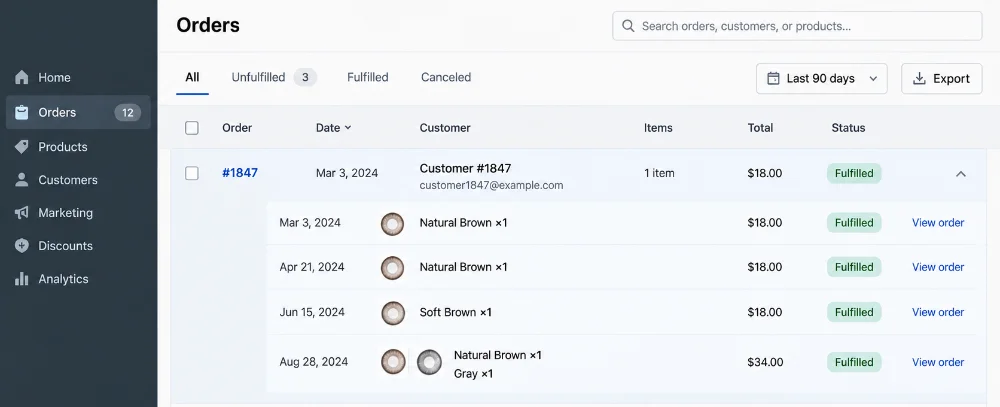
Imagine one customer beginning with Natural Brown, returning for Soft Brown, and later ordering Natural Brown together with Gray.
A narrow SKU-level view records only one direct Natural Brown reorder.
A customer-level view shows something more valuable: the original purchase helped establish an ongoing relationship with the assortment.
That does not mean every product that leads to another SKU should automatically be kept. Sales volume, margin, inventory requirements, and other commercial factors still matter.
But it gives the seller information that same-SKU repeat rate alone cannot provide.
This is also where customer behavior connects with assortment planning. How to Build a Balanced Colored Contact Lens Collection That Actually Sells looks at the different jobs products can perform within a collection. Repeat behavior can help reveal whether those roles are actually emerging after customers begin buying.
A Second Order Can Still Be Weak Evidence
Big Eye Brown creates another problem.
Suppose it has a strong first month, slows afterward, and then rises sharply when the seller runs a marketplace promotion.
Some previous customers return during the campaign.
Those are technically repeat orders.
But the seller still does not know whether the product is developing stable repeat demand or whether customers are simply responding to another attractive price.
The difference becomes clearer after the promotion ends.
If returning demand largely disappears until the next campaign, the promotion itself is carrying more of the sales burden.
That does not make the promotion unsuccessful. Discounts can serve useful commercial purposes.
It simply means the seller should be careful about what the resulting orders prove.
This matters especially on marketplaces where sellers can gradually become dependent on price as the main reason customers return. How to Sell Colored Contact Lenses on Shopee, Lazada, and TikTok Shop Without Competing Only on Price explores that problem in more detail.
Repeat Demand Should Change What the Seller Does Next
After several months, the seller no longer sees three products with a simple sales ranking.
Natural Brown was not initially the bestseller, but it keeps bringing some customers back to the same SKU.
Soft Gray has weaker direct reorders, yet customers who start there often continue into nearby products.
Big Eye Brown can generate strong sales, particularly when acquisition activity or promotions put it in front of new customers.
The next decision is not to declare one of them the winner.
It is to decide whether those different demand patterns should change how each product is managed.
For Natural Brown, consistent availability may become more important. If customers are returning specifically for that product, repeated stockouts can interrupt demand that already exists.
For Soft Gray, the seller may need to look beyond the individual SKU. If it repeatedly introduces customers to neighboring styles, evaluating the surrounding product group can reveal more than looking at Soft Gray alone.
Big Eye Brown may still deserve an important place in the assortment if it consistently attracts first-time customers. But the seller should know how much of that demand continues without promotion and how much must be recreated through campaigns.
This is where retention information begins to affect wholesale purchasing.
A reorder decision based only on total units sold treats all sales as if they carry the same information.
They do not.
A product selling steadily to both new and returning customers presents a different inventory situation from one that sells primarily during acquisition campaigns. A product with moderate direct reorders may look different again if it repeatedly moves existing customers into related SKUs.
None of those signals should determine purchasing alone.
Sales velocity, sell-through, remaining stock, stock coverage, channel performance, and customer feedback still matter. Repeat behavior simply adds another layer of evidence.
For a broader framework on those signals, see How to Use Sales Data to Decide Which Colored Contact Lens Styles to Restock.

Build on the First Sale Instead of Replacing It
A store can keep growing while repeatedly starting from zero.
New traffic brings a new customer. The customer places an order. The store then goes back to finding another new customer for the next sale.
A stronger product business gradually accumulates something from those first purchases.
Some customers return for exactly the same product. Others use the first successful choice as a starting point for exploring the assortment. Over time, those behaviors reveal which products create continuity, which help customers move into other styles, and which need a constant supply of new attention.
That information is useful beyond customer retention.
It can influence how products are presented, which styles need more reliable availability, how an assortment is structured, and eventually what the seller chooses to reorder.
The question is no longer simply which products sold.
It is which products gave customers a reason to come back—and what they bought when they did.
If you are building a colored contact lens assortment for ongoing retail or ecommerce sales, explore the UYAAI Wholesale Catalog to compare styles for different product roles and customer needs.