
Two retailers can sell the same colored contact lens designs and still need very different products.
Imagine a beauty retailer in Jakarta whose customers frequently ask for lenses to complete makeup looks, attend celebrations, or experiment with new styles. Most of these customers do not necessarily wear colored lenses every day.
Now consider an optical retailer in Kuala Lumpur. Its customers include regular contact lens wearers who return for replacements and expect detailed information about lens materials, care, and fitting.
Both stores may be interested in natural brown, gray, or enlarging lens designs. But stocking the same designs in the same replacement cycle would not necessarily make commercial sense.
For wholesale buyers, choosing between daily, monthly, and half-year colored contact lenses involves more than comparing replacement schedules or box prices. The decision affects customer suitability, product education, retail packaging, purchasing behavior, and the responsibilities of the selling channel.
Understanding those differences can help distributors build a product offering that their retail partners are equipped to sell and support.
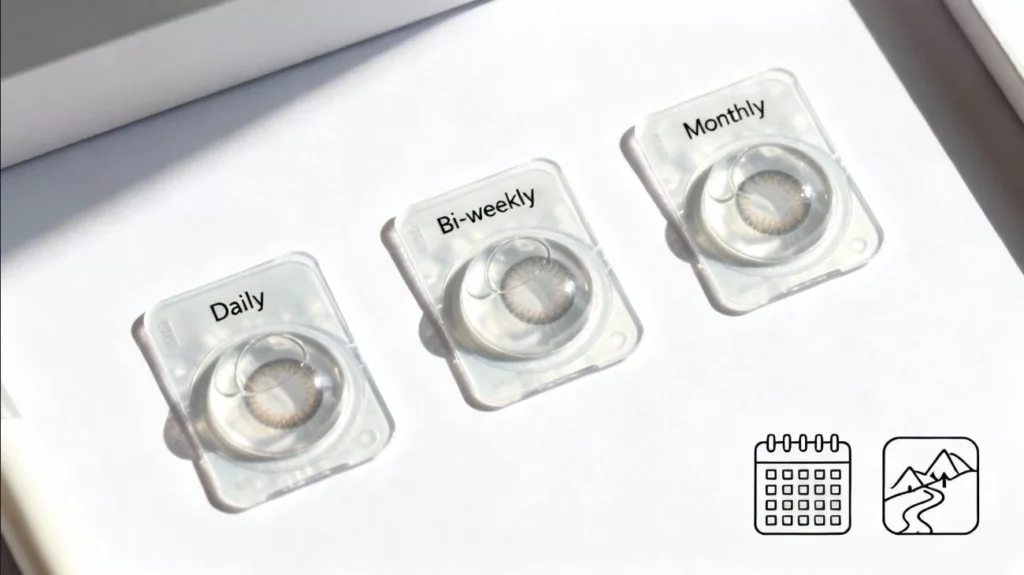
Daily vs. Monthly vs. Half-Year Colored Lenses at a Glance
The replacement cycle tells customers when a lens must be discarded according to its approved instructions. It does not determine how many hours the lens can be worn in a single day.
A half-year lens, for example, is not intended to remain in the eye continuously for six months. Monthly and half-year lenses generally require appropriate cleaning, disinfection, and storage between uses. Daily disposable lenses are discarded after a single use and must not be reused.
| Comparison | Daily Lenses | Monthly Lenses | Half-Year Lenses |
|---|---|---|---|
| Replacement cycle | Single-use disposable | Monthly replacement | Six-month replacement |
| Reuse | No | Yes, within approved instructions | Yes, within approved instructions |
| Cleaning and storage | Not required after disposal | Required between uses | Required between uses |
| Available materials | Product-dependent | Product-dependent | Product-dependent |
| Customer consideration | Single-use convenience | Reusable-lens routine | Longer replacement schedule |
| Retail responsibility | Correct use and disposal guidance | Care and replacement guidance | Care and replacement guidance |
| Wholesale consideration | Pack format and usage demand | Repeat-use demand and product support | Customer suitability and care support |
A shorter replacement cycle does not automatically produce more frequent retail purchases.
Someone who wears daily lenses twice a month may purchase less frequently than someone who wears monthly lenses regularly. A customer using reusable lenses might also buy several colors, depending on personal preferences and professional suitability.
For wholesalers, the more meaningful question is how often customers use a product, how they purchase it, and whether the retailer can support its intended use.
How Replacement Cycles Affect Comfort, Care, and Customer Expectations
Comfort often enters the conversation when retailers compare replacement cycles. However, a replacement schedule is not a reliable comfort rating.
Lens material, surface characteristics, fit, design, tear-film conditions, and wearing habits can all influence the experience.
The Practical Advantage of Daily Disposable Lenses
Daily disposable lenses eliminate the need to clean and store a used pair for another day.
For occasional wearers, this can make the care routine simpler. Customers open a fresh pair for use and discard it afterward, following the product’s approved wearing instructions.
Daily replacement also avoids carrying deposits accumulated on the same lens across multiple days of reuse.
These are practical advantages, particularly for customers who do not want to maintain reusable lenses.
They do not mean that every daily lens is more comfortable than every monthly or half-year lens.
A poorly fitted daily lens may cause discomfort, while a properly fitted reusable lens may be suitable for its intended wearer. The replacement cycle alone cannot resolve that comparison.
Retailers should avoid describing a product as universally more comfortable unless they have appropriate evidence supporting the specific claim.
Hydrogel vs. Silicone Hydrogel: Why Lens Material Matters
Colored contact lenses can use different material technologies, including conventional hydrogel and silicone hydrogel.
Silicone hydrogel materials generally allow more oxygen to pass through the lens than conventional hydrogel materials, although actual oxygen transmissibility depends on the specific product and its thickness.
That distinction matters because the cornea requires an adequate oxygen supply.
However, higher oxygen transmissibility does not automatically mean greater subjective wearing comfort.
Lens surface properties, design, fit, and individual eye conditions also affect how a lens feels. Material performance should be assessed using verified product specifications rather than marketing descriptions alone.
Silicone hydrogel is not exclusive to daily disposable lenses. Monthly silicone hydrogel colored lenses are commercially available, demonstrating that replacement cycle and material technology are separate product characteristics.
Within UYAAI’s current colored contact lens portfolio, silicone hydrogel technology is used in its daily disposable range. Buyers comparing UYAAI products should confirm the material and technical specifications of each selected SKU.
A retailer should not assume that all daily lenses use silicone hydrogel, or that all reusable colored lenses use the same conventional hydrogel formulation.
Reusable Lenses Require More Customer Support
Monthly and half-year lenses introduce an ongoing care responsibility.
Customers must understand the appropriate cleaning and disinfection routine, storage requirements, replacement schedule, and the importance of following professional guidance.
This creates an operational difference for retailers.
An optical store with trained staff and access to appropriate fitting services may already have processes for explaining reusable-lens care.
A beauty retailer with limited contact lens experience may need additional training and support before offering the same products.
Neither situation determines which replacement cycle is medically appropriate for an individual customer. That requires the relevant professional assessment and product instructions.
For distributors, however, it reveals an important distinction: some retail partners need more product education and service support than others.

The Business Trade-Offs Behind Each Replacement Cycle
A wholesale price list may show different prices for daily, monthly, and half-year products. Those numbers are only useful when the buyer understands what is included and how customers will use the lenses.
Consider a retailer comparing a daily multi-lens pack with a monthly product sold in a smaller pack.
Comparing the two box prices directly tells the retailer very little. The products may contain different numbers of lenses, represent different amounts of intended use, and require different care routines.
Even calculating the price per lens is not enough.
A reusable lens can serve multiple days within its approved replacement period, but the customer must also follow the necessary care requirements. A daily lens is used once, yet an occasional wearer may consume relatively few lenses over a month.
The relevant comparison depends on the customer.
Occasional Wear and Regular Wear Create Different Demand
For a customer who wears colored lenses mainly for celebrations or occasional makeup looks, a daily product may offer practical convenience.
The retailer still needs to establish whether customers accept the available pack format and its selling price.
A customer who wears lenses regularly may evaluate products differently. Monthly or other reusable options might suit some customers, provided they are appropriately fitted and able to follow the required care routine.
Neither pattern can be inferred from the replacement cycle alone.
This is why distributors should be cautious about using product replacement frequency as a direct forecast of repeat purchases.
A store selling daily lenses may have irregular purchasing intervals if its customers wear them infrequently. A store serving regular monthly-lens users may see a different purchasing rhythm.
The retailer’s actual sales records are more useful than assumptions about how frequently each category should sell.
Packaging Changes the Economics of an Order
Pack contents can influence the number of retail units a business can sell, its pricing presentation, and the amount of inventory committed to a product.
Suppose a wholesale buyer has two products under consideration:
- Product A is a daily disposable lens supplied in a multi-lens retail pack.
- Product B is a monthly reusable lens supplied in a smaller retail pack.
The buyer cannot decide which product represents better value by comparing wholesale box prices alone.
First, the buyer must establish the contents of each pack. Then the retailer needs to understand the intended customer usage pattern and how the product will be presented for sale.
For occasional-use customers, the total purchase price of a daily pack may matter more than a theoretical cost per day of wear.
For regular users, the cost associated with an intended wearing routine may be more relevant, although reusable-lens care requirements must also be considered.
Wholesale buyers should compare products on a consistent, clearly defined basis rather than treating every box as an equivalent unit.
This also affects minimum-order planning. A minimum expressed in pairs may not translate into the same number of retail boxes across different replacement cycles.
Confirming the actual ordering unit is essential before calculating how many saleable packs an order will provide.
A Broader Range Is Not Always a Better Range
Adding daily, monthly, and half-year versions of a popular design can increase the number of available product options.
It can also multiply the information a retailer must manage.
Each version may have different pack contents, material specifications, care instructions, available powers, and replacement labeling.
If a retailer’s customers have demonstrated demand for only one replacement cycle, adding the other two without a clear reason may create unnecessary inventory commitments.
On the other hand, a distributor serving several retail formats may benefit from carrying more than one replacement cycle because its partners have genuinely different customer needs.
The difference is whether each category serves an identifiable purchasing situation.
For broader assortment planning, see How to Build a Balanced Colored Contact Lens Collection That Actually Sells.
Which Replacement Cycle Fits Your Retail Channel?
In Southeast Asia, colored contact lenses may be distributed through beauty retailers, optical stores, ecommerce sellers, and businesses supplying several channels.
These retail formats differ in their customer relationships and service capabilities.
That does not mean every beauty store should sell daily lenses or every optical store should prioritize monthly products. The relevant factors are more specific.
| Retail Channel | Main Purchasing Consideration | What the Distributor Should Verify |
|---|---|---|
| Beauty retailers | Occasional versus regular use | Customer demand and ability to provide appropriate guidance |
| Optical stores | Professional service and customer suitability | Product specifications, fitting support, and replacement needs |
| Ecommerce sellers | Clear product information and customer expectations | Pack contents, care information, and permitted sales channels |
| Multi-channel distributors | Different requirements across retail partners | Product roles, documentation, and channel support |
Beauty Retailers: Match the Product to the Buying Occasion
A beauty store may attract customers through makeup tutorials, seasonal collections, and appearance-focused promotions.
Some customers may want colored lenses for a specific occasion. Others may become regular wearers.
The store should distinguish between these groups before deciding which replacement cycles to carry.
If occasional-use demand is significant, daily disposable lenses may deserve attention. But the store must still establish whether its customers are willing to purchase the available pack format and whether the business can meet applicable contact lens retail requirements.
For reusable products, the ability to explain care instructions becomes particularly important.
A distributor can support the retailer by supplying accurate product information and helping staff understand the differences between the available products.
Optical Stores: Evaluate the Customer’s Wearing Routine
Optical retailers may serve customers who regularly purchase contact lenses and expect more detailed technical information.
This can make monthly and other reusable products relevant to their assortment, depending on customer needs and professional suitability.
However, regular wearing habits do not automatically make reusable lenses the preferred choice.
Some customers may favor daily disposables for convenience or other individual reasons.
Optical retailers should make product recommendations within the scope of appropriate professional fitting, product indications, and customer requirements.
For their wholesale suppliers, consistent access to accurate specifications and product documentation is particularly important.
Ecommerce Sellers: Product Information Becomes Part of the Sales Process
Online selling introduces a different challenge.
Customers may encounter a colored contact lens listing through a photograph, short video, or marketplace search result without receiving an in-person explanation.
This makes accurate product descriptions essential.
A listing should clearly communicate the replacement cycle, lens material, pack contents, relevant specifications, and care requirements.
For sellers using Shopee, Lazada, TikTok Shop, or other platforms, the business must also verify that the specific contact lens products can legally be sold through the intended channel and that all applicable platform and market requirements are met.
An attractive product image cannot compensate for unclear replacement instructions.
Distributors: One Market Can Contain Several Types of Demand
A distributor supplying stores in Indonesia, Malaysia, Thailand, or Vietnam may work with partners whose customers use colored lenses very differently.
The distributor should avoid assigning the same product mix to every retailer merely because the businesses operate in the same country.
There are also market-specific requirements to consider.
Product authorization, labeling, language requirements, and permitted sales channels can vary by destination. A product available for one market should not automatically be assumed eligible for another.
The same applies to supply arrangements. Regional stock availability and ordering conditions should be confirmed for the actual products and destinations involved.
A distributor that understands these differences can provide more useful recommendations than one that offers every retailer the same assortment.
For more on supporting downstream stores, see How Colored Contact Lens Distributors Can Help Retail Partners Sell More.

Two Retailers, Two Different Wholesale Priorities
The commercial differences become clearer when applied to actual purchasing situations.
Consider two fictional retailers evaluating their next colored contact lens order. Both are established businesses, but their customer demand and operating capabilities differ.
Retailer A: Customers Want Convenience, but Price Still Matters
Retailer A operates a beauty-focused store in Jakarta.
Its colored lens customers are often interested in specific makeup looks, social events, or seasonal styles. Many purchase lenses occasionally rather than wearing them every day.
The store has noticed interest in convenient, single-use products and begins considering daily disposable lenses.
There is a complication.
Customers who wear lenses only occasionally may appreciate the convenience of daily products but still hesitate when comparing the total price of a retail pack with a reusable alternative.
The retailer cannot resolve that hesitation simply by explaining that daily lenses are convenient.
It needs to understand how many pairs customers expect to use, which pack formats they are willing to purchase, and whether the product fits their actual buying occasions.
The owner also considers half-year lenses because their longer replacement period may appear economical.
Yet that choice introduces a different concern. The store has limited experience explaining reusable-lens care, and some customers may not be prepared to maintain the required cleaning and storage routine.
The store therefore has two separate questions to answer.
First, is there sufficient customer demand for the available daily products at an acceptable retail price?
Second, does the business have the professional support and operational readiness required to offer reusable lenses appropriately?
A sensible next purchasing decision would be to evaluate actual customer requests and available pack formats before committing to a large range.
Daily lenses may become an important part of the assortment, but the evidence needs to come from the store’s customers rather than an assumption that occasional wearers always prefer daily products.
Retailer B: Regular Customers Do Not All Want the Same Routine
Retailer B is an optical retailer in Kuala Lumpur with an established contact lens customer base.
Its customers include regular wearers who return for replacements. The store has experience explaining product specifications and providing access to appropriate fitting services.
Monthly lenses appear to be a natural category to evaluate.
However, the retailer notices a difference among its customers.
Some are comfortable following reusable-lens care routines and want products suited to their regular wearing habits.
Others prefer not to manage cleaning solutions and storage cases, even though they wear lenses frequently.
The store cannot serve both groups effectively by assuming that regular use automatically means monthly lenses.
It also considers whether half-year products should be added.
Before doing so, the retailer needs to establish whether there is genuine demand for the specific products, whether customers are suitable candidates, and whether the store can support their approved care and replacement requirements.
For this business, a carefully selected range of daily and monthly products may address different customer preferences. Half-year lenses would require their own demand and suitability assessment rather than being added solely because they offer a longer replacement cycle.
What Their Purchasing Decisions Reveal
Retailer A’s main uncertainty is whether occasional-use convenience translates into demand for the available daily packs.
Retailer B’s challenge is serving regular customers with different preferences and product requirements.
Both retailers may sell similar colors and designs, but the reasons customers choose those lenses are not identical.
A distributor advising these businesses should begin with their customer usage patterns, retail capabilities, and available product specifications.
The replacement cycle becomes a purchasing decision only after those conditions are understood.
What to Verify Before Ordering Colored Contact Lenses Wholesale
Once a buyer identifies a suitable replacement cycle, the next step is to verify the actual products.
Six details deserve attention:
- Approved replacement schedule: Confirm the exact replacement and wearing instructions for each product. Do not assume all products within a category use identical labeling.
- Material and specifications: Verify the material, available powers, base curve, diameter, and other relevant product details.
- Pack contents and ordering units: Check the number of lenses or pairs per retail pack and how wholesale quantities are calculated.
- Care and customer support: Confirm the instructions and professional support needed for the intended products.
- Destination-market requirements: Verify product-specific authorization, labeling, and applicable retail or professional requirements.
- Available assortment and supply: Confirm which styles and specifications are available in the chosen replacement cycle and destination market.
These checks address the differences between the product categories. A separate supplier assessment should cover documentation reliability, commercial terms, and ongoing supply arrangements.
For that broader evaluation, see How to Evaluate a Colored Contact Lens Wholesale Supplier Before Your First Order.
Explore UYAAI’s Daily, Monthly, and Half-Year Colored Contact Lenses
UYAAI supplies colored contact lenses for branded wholesale and distribution, with a focus on Southeast Asian retail markets.
Its product range includes daily, monthly, and half-year replacement options, allowing wholesale buyers to explore products for different customer needs and sales channels.
UYAAI offers daily disposable colored contact lenses in different lens materials, including selected silicone hydrogel options. Material specifications, available designs, powers, pack formats, and ordering conditions should be confirmed for each selected product.
For standard branded wholesale, UYAAI’s general entry quantity starts at 100 pairs, with a minimum of 5 pairs per SKU. Because retail packaging and ordering units may differ by replacement cycle, buyers should verify the applicable terms for their intended assortment.
A suitable wholesale range begins with the customers your retail partners actually serve—not simply the number of replacement cycles available in a catalog.
Explore available styles and replacement-cycle options for your wholesale or distribution business.